All posts by imreal

Retail Employees and their Customers Need Protection


SafeGuard® Screen – a low cost and simple to install acrylic screen which creates a timely safety barrier for everyone at the point of sale.

Apple, Walmart, and Olive Garden are some of the major employers that are taking the lead in changes to their sick leave polices as Coronavirus continues to baffle the world. Over 30 million U.S. workers, most them working in restaurants, stores and airports, are highly acutely concerned about their company benefits, safety and health while at work.

With eating out currently not an option, it is no surprise that rationing of some products has inevitably increased dining at home. This, and irrational panic buying, has led to a 30% to 56% rise in online shopping in the U.S. and Canada, creating a strain on the supply chain, according to DigitalCommerce360.com. It has also caused significant pressure on those employed across the store, but it is the staff-customer interaction at the point of sale where the current situation has created the need to re-evaluate the personal well being and security of the checkout associates and their customers.

Providing a safe working and purchasing environment will provide peace of mind for all. Retailers should enable social distancing and demonstrate to both customers and employees that the store takes their well being very seriously. This is important since it is where the loyalty of the future may well reside. With increasing options, customer treatment by retailers in these extraordinary times is unlikely to be forgotten and will influence where consumers spend their money.

SpacePole, Inc., an Ergonomics Solutions company, has a range of technology mounting solutions now offering the SafeGuard® Screen – a low cost and simple to install acrylic screen which creates a timely safety barrier for everyone at the point of sale. The screen can easily retrofit to existing SpacePole installations or complement existing hardware without taking up any transactional space either in the packing or payment areas. SpacePole SafeGuard® Screens are perfect for all types of food and non-food retail as well as hospitality and healthcare environments.

It is an unobtrusive solution which does not affect the current operator/customer interface. For example, the customer display can be on the customer side of the screen along with the payment terminal and loyalty scanner. As with all SpacePole products, the screen can be customized, as part of an existing or new installation. Cleanliness is paramount and the acrylic surface can be easily cleaned with soapy water without causing any damage or degradation to the surface.

About SpacePole, Inc.

SpacePole, Inc., an Ergonomic Solutions company, is a leading supplier of innovative and ergonomically designed technology mounting and mobility solutions with 8 million solutions installed worldwide. Developed in partnership with global retailers and technology suppliers, SpacePole products are modular, proven in the field, cost-effective to upgrade, and protect against tamper and physical damage.

Website: http://www.spacepole.com

LinkedIn: https://www.linkedin.com/company/spacepole-inc

Twitter: https://twitter.com/SpacePole_Inc

Share article on social media or email:


Envoy Mortgage Announces Hiring of Amber Holligan as Senior Vice President and Director of Underwriting


News Image

“Amber’s knowledge is remarkable; she’s passionate about the business, caring, a great leader and dedicated to elevating teams and we’re excited she chose Envoy,” said Kim Hoffman, CMB, AMP, and COO of Envoy Mortgage.

National mortgage lender, Envoy Mortgage, announced that Amber Holligan is joining the company as Senior Vice President and Director of Underwriting. Holligan brings deep credit and mortgage knowledge to Envoy, having served most recently as Vice President of Underwriting for Mr. Cooper and previously as Director of Underwriting for Pacific Union Mortgage.

Holligan joins Envoy as an accomplished industry expert with more than 15 years of lending expertise in roles ranging from loan origination, processing, underwriting, operations and leadership. Her well-rounded knowledge of the mortgage landscape will complement the organization and drive impactful process improvements and operational efficiencies.

In previous positions, Holligan strategically oversaw the success and development of sizeable enterprises, including a team of four underwriting managers and 42 underwriters. Holligan is experienced in employee development and specializes in performing calculated daily underwriting audits for quality management, loan delivery edits for distributed retail and verification of daily production and goal management for loan originators that work remotely or centrally.

In her new role, Holligan will oversee all mortgage underwriting, including four regional credit centers, a staff of 50 and all credit-related projects.

“I’ve known Amber for several years and knew she’d be the perfect fit for our organization. Her knowledge is remarkable; she’s passionate about the business, caring, a great leader and dedicated to elevating teams and we’re excited she chose Envoy,” said Kim Hoffman, CMB, AMP, and COO of Envoy Mortgage.

About Envoy Mortgage:

Founded in 1997, Envoy Mortgage is an independently owned national mortgage lender headquartered in Houston, TX dedicated to serving retail originators exclusively to allow them to serve their customers and grow their businesses. As a Fannie, Freddie and Ginnie approved seller/servicer, Envoy offers a full menu of loan products with locations across the U.S. Licensed in 48 states, Envoy branches deliver outstanding customer service while offering a full menu of loan products with the tools, expertise and technology needed to support all functions of the mortgage process. More information is available at http://www.EnvoyMortgage.com. Envoy Mortgage, Ltd. NMLS #6666.

Share article on social media or email:

The New Jersey Appellate Division upheld a verdict in favor of former corrections officer Shelley Pritchett, on April 24, 2020


The New Jersey Appellate Division upheld a verdict in favor of former corrections officer Shelley Pritchett, on April 24, 2020, to whom a jury awarded an approximately $11.8 million verdict against the New Jersey Department of Corrections in June of 2017.

That jury found that the Department of Corrections discriminated against Ms. Pritchett after she was diagnosed with multiple sclerosis. The jury also found the Department failed to provide her with a reasonable accommodation due to the diagnosis. The jury awarded Ms. Pritchett over $1.8 million in economic damages and emotional distress, and $10 million in punitive damages.

The Appellate Division upheld the verdict both as to liability and as to damages. In the Court’s opinion, it rejected the State’s argument that the punitive damage award was excessive, reasoning that the “punitive damages award in this case was a single-digit multiplier of the compensatory award, less than 7:1, making it more likely to comport with due process…”. The Court did remand the case back to the Trial Court for “further proceedings on the quantum of punitive damages.” The case docket is Docket No. A-001956-17.

“We’re all very proud of the work of partners Drake P. Bearden, Jr., whose inspired advocacy resulted in this verdict, and Deborah L, Mains, whose brilliant and insightful advocacy and brief work, on appeal, so thoroughly protected our client’s result,” offers partner Kevin Costello. “Justice has been done, and our fight for Ms. Pritchett will continue.”

Share article on social media or email:

New DSCC Report Shows Samsung Increased Advanced TV Market Share in Q1’20


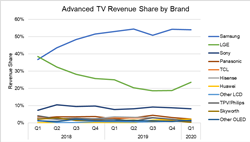
Advanced TV Revenue Share by Brand

Advanced TV revenues are forecast to grow by a 9% growth rate from 2019 to 2025 to $26 billion, according to the new DSCC Quarterly Advanced TV Shipment and Forecast Report, introduced this week and now available to subscribers. This report covers the worldwide premium TV market, including the most Advanced TV technologies: WOLED, QD Display, QDEF, Dual Cell LCD and MiniLED with 4K and 8K resolution. This report looks at current and future TV shipments and revenues by technology, region, brand, resolution and size, and forecasts the growth of all of these technologies. The report includes the preliminary shipment result for Q1 2020, a forecast by quarter for 2020 and an annual forecast to 2025.

Advanced TV is defined as any TV with an advanced display technology feature, including all OLED TVs, 8K LCD TVs and all LCD TVs with quantum dot technology. The historical data in the report allows analysis by feature for advanced LCD TVs, including:

  • QDEF TV: TV using a Quantum Dot Enhancement Film; these TVs are sold as “QLED” by Samsung, TCL and others.
  • MiniLED: LCD TVs with a MiniLED backlight, as sold by TCL starting in 2019.
  • Dual Cell: LCD TVs employing dual-cell technology, as introduced by Hisense in 2019.
  • LCD Others: this category includes LCD TVs with 8K resolution, that do not fall in any other category.

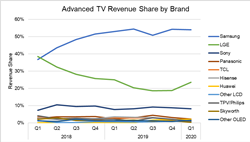
The report’s pivot tables allow analysis of brand share by screen size, region, technology, resolution and other variables. In Q1 2020, among all Advanced TV products Samsung increased its revenue share to 54% from 53% in Q1 2019 by expanding its QDEF product line into more affordable models. LG held the #2 brand position in Q1 2020 with 24% revenue share, while Sony took the third spot with 8%.

The PowerPoint report includes analysis of brand share by region and product segment, allowing a more focused view of brand share battles. The share battle in China has gotten increasingly intense, with four companies with double-digit % market share. Samsung’s share of Advanced TV in China increased to an all-time high in Q1 with 42% unit and revenue share and Huawei has emerged as a major player in Advanced LCD TVs, capturing an 18% share in Q1. Hisense introduced OLED TV in 2019, but this did not prevent the company’s share from eroding to 14% in Q1. LGE fares poorly in China with less than a 5% share. Skyworth, once a major player with 24% share in Q2 2018, has seen its position diminish to only 3% share in Q1 2020.

The report allows detailed analysis of historical shipment patterns, but also provides DSCC’s forecast of technology, product and pricing. While the COVID-19 impact will slow growth in Q2 2020 to 11% Y/Y, growth will resume in the second half of 2020 and Q4 unit growth will reach 27% Y/Y. 48” OLED will start in limited volumes, adding to the product mix for OLED, and LGD’s increasing OLED capacity will allow OLED to hold its unit share of Advanced TV and increase OLED’s revenue share. Across all technologies and sizes, we expect Advanced TV unit shipments to increase by 30% in 2020 compared to 2019.

Turning to the long-term forecast, we expect that Advanced TV shipments will grow from less than 10 million in 2019 to nearly 35 million in 2025, a 24% CAGR for that time period. OLED TV units are expected to grow at a 31% CAGR from 2019-2025 to 14.7 million units, while advanced LCD TV units are expected to grow at a 21% CAGR to 20.8 million units. The largest sizes will see the biggest growth, with growth in 75”+ expected to be 36%, and growth in 75”+ OLED even higher at 87% CAGR.

From a revenue standpoint, while the overall category will see revenue growth, OLED TV is expected to capture all the revenue growth in Advanced TV, as advanced LCD revenues are expected to be the same in 2025 compared to 2019. OLED TV revenues are expected to grow at a 19% CAGR from 2019-2025 to $16.2 billion. Advanced LCD TV revenues were $10.0 billion in 2019, are expected to peak at $11.1 billion in 2022-2023, then decline to $10.0 billion by 2025. Even larger size LCD TVs are not expected to have revenue growth as Samsung shifts its emphasis from its “QLED” LCD products to QD OLED.

DSCC’s Quarterly Advanced TV Shipment and Forecast Report includes technical descriptions of all major Advanced TV display technologies, plus quarterly shipment results from Q1 2018 through Q1 2020 preliminary results, sortable by technology, region, brand, resolution and size, and includes pivot tables for analysis of units, revenues, ASPs and other metrics. The report includes DSCC’s quarterly forecast for the current year plus an annual forecast for five years across technology, region, resolution and size. Readers interested in subscribing to the DSCC Quarterly Advanced TV Shipment Report should contact gerry@displaysupplychain.com.

About Display Supply Chain Consultants (DSCC)

Display Supply Chain Consultants (DSCC) was formed by experienced display market analysts from throughout the display supply chain and delivers valuable insights through consulting, syndicated reports and events. The company has offices in Korea, China, Japan and the US, is on the web at https://www.displaysupplychain.com and can be reached in the US at info@displaysupplychain.com and (512) 577-3672.

Share article on social media or email:

4 Fitness Brands Unite to Offer $20M in Incentives to Help Gyms Retain Members While Closed


#StayforMay Give Back Program

With over 90% of gyms shut down due to COVID-19, many are struggling…we feel a moral obligation to help gym owners do everything they can to stay in business, and knowing that membership dues keep the lights on, we’re hopeful this program helps gyms retain more members in May.

Thousands of independently owned and operated gyms have been forced to shut down as a result of COVID-19 and are struggling to retain members. In efforts to give back, four fitness brands have united to give gyms over $20M in incentives to offer their members who continue to keep their memberships active for the month of May.

The #StayforMay initiative is spearheaded by O2 Recovery Drink, an oxygenated recovery drink brand sold at grocery stores, online, and gyms throughout the United States that have been negatively impacted by COVID-19. O2, along with partner brands Born Primitive, Puori, and Bear KompleX, recently pledged 50% of profits from online sales in March and April to be donated back to gym owners. Now, they’re offering a combined $100 gift card to every gym member in America who belongs to a gym that has participated in their profit-sharing program (over 2,000 gyms to date) as long as the member continues to pay his or her membership dues for the month of May.

“Gym owners are some of the most critical members of our society responsible for keeping our community fit and healthy, which is more important now than ever,” said Dave Colina, O2’s Founder & CEO. “With over 90% of gyms shut down due to COVID-19, many are struggling to retain their members, and we don’t believe enough is being done for them. We feel a moral obligation to help gym owners do everything they can to stay in business, and knowing that membership dues keep the lights on, we’re hopeful this program helps gyms retain more members in May than they otherwise would have.”

“WOW!!!!!!! This just made me have a bit more hope. I am sending out an email about May memberships this week, and this is going to help myself and so many other gym owners out there,” said the owner of one participating CrossFit gym in Michigan.

“This is what effective help looks like. It’s literally more than my government or bank has done,” said the owner of another participating CrossFit gym in Ohio.

So far, the profit-sharing initiative has raised well into the six figures to be donated back to participating gyms. Gym members from all over the United States have rallied in support of their gym owners and favorite instructors, and the proof is in the voice of the fitness community. So far, the number of people across the United States that have supported their local gym as a result of the initiative is over 10,000 and growing exponentially each day. The gift card initiative is the final extension of that program, and gyms can enroll to offer this to their members until May 1.

If you are an independent gym owner that has been forced to close because of COVID-19, visit drinko2.com/stayformay to learn more about participating in this program.

About O2

Now more than ever, people are working out like elite athletes, but not taking the time to recover like the pros. O2 is making recovery more accessible, enjoyable, and convenient to help solve that problem. Developed by a physician and a CrossFit® trainer, O2 is a non-carbonated, keto-friendly recovery drink blending oxygenated water with electrolytes to help athletes accelerate their recovery without compromising their health.

Spend less time recuperating and more time accomplishing. Check out drinko2.com for more info and follow @drinko2recovery on Instagram.

Share article on social media or email:

Picis Announces Release of PriorityQ, Proactive Prioritization Planning for Surgical Scheduling


PriorityQ by Picis

PriorityQ by Picis

“The benefit to healthcare providers is PriorityQ goes beyond a patient prioritization score. The real value of the solution is that it uses the “score” in conjunction with the hospital’s particular parameters to generate a forward looking schedule.” -Marcus Perez, EVP

Picis announces the release of PriorityQ, a web-based solution designed to assist healthcare providers in managing surgical backlogs and waitlists through proactive prioritization planning.

As a result of the current global pandemic, clinicians have been forced to suspend non-urgent, elective procedures to protect resources to combat the surge of life-threatening COVID-19 cases.

Marcus Perez, Executive Vice President of Picis states, “As existing surgical backlogs continue to grow exponentially and facilities begin to resume elective surgeries, a daily process of meeting as a committee to manually review a triage list of patients is simply not scalable or efficient when so many patients are in need of care.”

As experts in surgical scheduling, Picis introduces PriorityQ to help administrators coordinate the surgical schedule based on aggregated data. Incorporating hospital thresholds, patient severity level, OR time and resources, PriorityQ collects multiple data points to determine a patient “score” and delivers a priority of surgical procedures over the coming weeks and/or months. For organizations that already have a prioritization scoring system, PriorityQ will import this information and include it in the factored results. This information empowers administrators with the ability to plan how to manage the queue, separate surgeries by service, while producing financials to show potential revenue generated based on the suggested schedule.

“The benefit to healthcare providers is PriorityQ goes beyond a patient prioritization score. The real value of the solution is that it uses the “score” in conjunction with the hospital’s particular parameters to generate a forward looking schedule. Simply put, it’s load planning. The key is providing each facility the flexibility to modify the schedule once scores are delivered and the ability to plan in advance how to manage the queue.” said Perez.

PriorityQ will be ready for implementation the week of May 4, 2020. To learn more, visit our website http://www.picis.com.

ABOUT PICIS:

Picis Clinical Solutions (Picis) is a global provider of clinical information solutions that automate the entire perioperative experience with one contiguous patient record, from preop to intraop and anesthesia through PACU. Picis continues to focus and specialize the integrated suite of solutions in life-critical areas of the hospital where the patients are the most vulnerable, the care process is the most complex, and an increasing majority of hospital costs and potential revenue are concentrated. The software enables rapid, sustained delivery of clinical documentation, and financial and operational results. From department performance to patient case costing, hospitals benefit from the ability to interact with the data needed to help clinicians improve patient care, engagement and hospital revenue goals. Picis Clinical Solutions, a wholly owned subsidiary of N. Harris Computer Corporation, is headquartered in Wakefield, Massachusetts with licensed systems for use at more than 400 hospitals worldwide.

Share article on social media or email:

Shady Grove Fertility (SGF) Expected to Resume Full-Service Care across All States by May 15, 2020


Shady Grove Fertility (SGF) announces expected full service dates.

We’re extremely encouraged by our patients and their tenacity, persistence, and resilience in the face of such challenging times. We remain available to help them build their families in a safe environment.

Shady Grove Fertility (SGF) announced today it is expected to resume full-service fertility procedures and treatments at select locations over the coming days and weeks, with many essential services already available.

SGF Fertility Treatments Available Immediately

Specifically, patients in need of a virtual physician consultation, diagnostic testing, ovulation induction (OI), intrauterine insemination (IUI), frozen embryo transfer (FET), in vitro fertilization (IVF) for at-risk patients, and oncofertility preservation may start or resume treatment immediately.

SGF Fertility Treatments Available Soon

Patients in need of IVF, donor egg treatment, or gestational carrier treatment will have the option to start or resume treatment on the following dates:

New York: April 27, 2020

Richmond, VA: May 4, 2020

Maryland, Northern Virginia, D.C.: May 10, 2020

Pennsylvania: May 11, 2020

Georgia: Week of May 11, 2020

Florida: May 15, 2020

Infertility is a Time-Sensitive Medical Diagnosis

Due to the tremendous efforts of thousands of frontline healthcare professionals and the community at large, many regions with the United States who were once dramatically affected by the COVID-19 crisis are finally beginning to experience a reduction in the number of new cases and hospitalizations.

“While this is not business as usual, we were able to come up with care solutions that we can offer in a safe, very new and different environment; an environment that allows access to care with appropriate protection against the spread of COVID-19. As part of the medical community, we recognize the unique challenges an infertility diagnosis presents. It’s a disease that has an enormous time-sensitivity attached to it, as well as physical, emotional, and financial implications. Many of our patients have been actively trying for months, or more often, years to have a baby,” said Eric A. Widra, M.D., SGF Chief Medical Officer and board certified reproductive endocrinologist, who sees patients in SGF’s Washington, D.C., locations.

“We believe healthy people should not be denied access to care if it does not unduly threaten public health or drain resources from the healthcare system. As freestanding, non-hospital-based, single specialty treatment centers, the resources SGF utilizes treat patients do not draw from the same pool as those available to take care of patients suffering from COVID-19 and other serious conditions,” added Widra.

“We’re extremely encouraged by our patients and their tenacity, persistence, and resilience in the face of such challenging times. We remain available to help them build their families in a safe environment,” added Widra.

For SGF’s most up-to-date safety guidelines, visit ShadyGroveFertility.com or follow SGF on Facebook or Instagram.

To schedule a new patient virtual physician consult, call 1-888-761-1967.

About Shady Grove Fertility (SGF)

SGF is a leading fertility and IVF center of excellence with more than 85,000 babies born and counting. With 38 locations throughout FL, GA, MD, NY, PA, VA, D.C., and Santiago, Chile, we offer patients virtual physician consults, individualized care, accept most insurance plans, and make treatment affordable through innovative financial options, including treatment guarantees. More physicians refer their patients to SGF than any other center. Call 1-888-761-1967 or visit ShadyGroveFertility.com.

Share article on social media or email:


Shady Grove Fertility (SGF) New York Resumes Full-Service Fertility Procedures and Treatments


SGF New York announces it will resume full service fertility treatments starting April 27, 2020.

Patients in need of a virtual physician consultation, diagnostic testing, ovulation induction (OI), intrauterine insemination (IUI), frozen embryo transfer (FET), in vitro fertilization (IVF), donor egg treatment, and oncofertility preservation may start or resume treatment immediately.

SGF New York announced this week it has resumed fertility procedures and treatment at its flagship New York location.

Due to the tremendous efforts of thousands of frontline healthcare professionals and the community at large, many regions with the United States who were once dramatically affected by the COVID-19 crisis are finally beginning to experience a reduction in the number of new cases and hospitalizations.

SGF Fertility Treatments Now Available

Specifically, patients in need of a virtual physician consultation, diagnostic testing, ovulation induction (OI), intrauterine insemination (IUI), frozen embryo transfer (FET), in vitro fertilization (IVF), donor egg treatment, and oncofertility preservation may start or resume treatment immediately.

SGF New York’s Accomplished Physician Team

SGF New York is home to two of the region’s most accomplished, Cornell-trained physicians, Anate Brauer, M.D., SGF New York IVF Director, and Tomer Singer, M.D., MBA., SGF New York Medical Director. Both physicians offer a full range of state-of-the-art in-house diagnostic and treatment options for female and male infertility, elective fertility preservation, fertility preservation prior to cancer treatment, third-party reproduction, and LGBTQ family building.

“This is not business as usual. We will be providing care for patients in a new, very different environment. Fortunately, we’ve been able to come up with care solutions—with safety considerations being of paramount importance—that allow patients to obtain the care they need,” said Eric A. Widra, SGF Chief Medical Officer.

Dr. Brauer earned her medical degree from the George Washington University School of Medicine, where she was elected to the prestigious Alpha Omega Alpha medical honor society. She completed her residency in Obstetrics and Gynecology at New York Presbyterian Hospital-Weill Cornell Medical Center. Dr. Brauer subsequently completed her fellowship training in Reproductive Endocrinology and Infertility at the Ronald O. Perelman and Claudia Cohen Center for Reproductive Medicine and Infertility-Weill Cornell Medical College. Prior to joining Shady Grove Fertility, Dr. Brauer was an Assistant Clinical Professor at NYU School of Medicine.

Dr. Singer earned his medical degree from the Sackler School of Medicine and his Master of Business Administration in Health Care Management from Hofstra Zarb School of Business. He completed his residency training in obstetrics and gynecology at Lenox Hill Hospital in New York, NY, where he also served as Chief Resident. He then went on to complete his reproductive endocrinology and infertility fellowship at Weill Cornell Medical College in New York, NY.

Drs. Brauer and Singer are accepting new patients. Call 212-203-4826 or submit this brief form to schedule a virtual physician consult.

About Shady Grove Fertility (SGF)

SGF is a leading fertility and IVF center of excellence with more than 85,000 babies born and counting. With 38 locations throughout FL, GA, MD, NY, PA, VA, D.C., and Santiago, Chile, we offer patients virtual physician consults, individualized care, accept most insurance plans, and make treatment affordable through innovative financial options, including treatment guarantees. More physicians refer their patients to SGF than any other center. Call 1-888-761-1967 or visit ShadyGroveFertility.com.

Share article on social media or email:

National Survey Reveals How COVID-19 Will Change U.S. Grocery and Restaurant Consumer Food Purchasing Preferences


Eating 2020: How COVID-19 Will Change Consumer Engagement With Food

“These findings contribute data to what we’ve believed to be true, that both restaurants and groceries should prepare to meet consumer expectations for health and safety for some time to come,” said Hinda Mitchell, president of Inspire PR Group.

Leading Columbus-based, national PR firm, Inspire PR Group, and full-service market research firm, Illuminology, today released the results of a nationwide survey, Eating 2020: How COVID-19 Will Change Consumer Engagement With Food, which gauged more than 1,800 U.S. consumers’ food purchasing trends before, during and after the COVID-19 stay-at-home restrictions.

Key results indicate that health and safety will remain a top concern for consumers once stay-at-home restrictions are lifted. The vast majority of those surveyed want grocery stores and restaurants to have employees wear face masks and encourage social distancing. However, when presented with all safety options, shoppers and diners are most concerned about the perceived health threat posed by other customers, more so than employees.


  • “These findings contribute data to what we’ve believed to be true, that both restaurants and groceries should prepare to meet consumer expectations for health and safety for some time to come,” said Hinda Mitchell, president of Inspire PR Group. “Clearly defined protocols around how these businesses will keep their customers safe – mostly from other customers – will be critical to restoring trust and confidence.”

Online to Decline

Additional insights reveal that although grocery chains saw a surge of new customers for online pickup and delivery orders in April 2020, these platforms are likely to see significant declines back to pre-COVID-19 levels or lower after stay-at-home restrictions are lifted. The survey found that of the recently acquired shoppers, more than one-third are unlikely to use online pickup and nearly half are unlikely to use online delivery when restrictions are lifted.

Dine-In to Return (but Slowly)

Consumers who dined in at restaurants before the pandemic are likely to return when restaurant-specific orders lift – and that’s good news for U.S. restaurants. However, projections suggest that there could be a 20 percent difference in dine-in traffic over pre-COVID-19 levels. Also, restaurants that focus more on quality dine-in experiences (e.g. upscale restaurants, local/neighborhood restaurants, and fast casual restaurants) are more likely to return to pre-COVID-19 levels.

The research was conducted April 17-20, 2020, and surveyed 1,300 U.S. consumers and an additional sample of 500 Ohio consumers. The survey asked respondents about their grocery and restaurant behaviors in the first two months of 2020 before COVID-19 became a crisis in the U.S., behaviors during stay-at-home orders in April, and how consumers anticipate their behaviors will change in the first 60 days following when orders are lifted.

“Overall, these data tell a story of consumers’ changing purchase patterns before, during, and after an incredible shock to our economic and health systems,” said Orie Kristel, CEO of Illuminology. “Groceries and restaurants need to be especially cautious when planning their operations after COVID-19 stay-at-home restrictions are lifted. Although many customers likely crave a great dining or shopping experience, many customers are also concerned about potential monetary or health issues.”

Additional insights from the U.S. survey of 1,300 respondents revealed:

Grocery Store Behaviors Will Change

  • Stockpiling extra nonperishable foods and household supplies is likely to continue, with four in 10 respondents saying they are very likely to buy and store these items after stay-at-home restrictions are lifted.
  • Consumers are fearful of other shoppers making them ill. Approximately 23 percent of shoppers most prefer that customers wear face masks and 18 percent prefer that the number of customers in the store be limited.
  • When the shelter-in-place restrictions are lifted, in-store visits will increase, but online shopping will decrease or remain flat.

Restaurant Behavior Insights

  • Thirty-seven percent of diners are extremely or very worried about getting sick from other customers if they eat a meal inside a restaurant.
  • While carryout, drive-thru and food delivery nearly doubled from once every two weeks to once per week, frequency of these services is projected to decrease significantly after stay-at-home restrictions are lifted.
  • All restaurant sectors, with the exception of fast food/QSR, saw dramatic decreases during COVID-19 restrictions, however most sectors are projected to see a return to pre-COVID-19 levels of visits.
  • Restaurant spending is a concern, with more than 60 percent feeling they could not pay or would worry about paying $75 for a family dinner out, suggesting the pandemic’s economic toll is a continued impact on the sector.
  • After COVID-19 restrictions lift, dine-in visits to restaurants will increase but not to pre-stay-at-home levels (45 percent of people will dine inside a restaurant soon after COVID-19 restrictions are lifted vs. 67 percent pre-COVID-19 restrictions).

Consumer Behaviors from One of the Early States to Issue a Stay-at-Home Order

The research also sampled more than 500 respondents in Ohio, which was among the first wave of states to adopt the stay-at-home measures and has seen “flattening” of the case curve. Under the leadership of Governor Mike DeWine, Ohio has been notably aggressive in its response to COVID-19, and the state mounted a broad public information campaign to educate residents.

Although the consumer behaviors between the Ohio and national research draw many similarities, one significant finding is that Ohioans are statistically less likely to be extremely or very worried about getting sick from COVID-19 compared to the nation as a whole, 33 percent vs. 41 percent, respectively.

The full report and methodology can be downloaded at InspirePRGroup.com.

###

ABOUT INSPIRE PR GROUP

Inspire PR Group is a full-service public relations and digital agency that serves as a trusted partner to valued clients including nationally recognized brands, businesses, trade associations and non-profits. Inspire works across multiple sectors such as hospitality, restaurant, food and beverage, retail, non-profit, visitor and tourism, local government, agriculture, pets, energy and real estate. The agency is drawn to companies and organizations with strong social impact and sustainability goals. As part of its own efforts to give back, Inspire recently launched Inspiring Good, an annual grant program that provides pro bono PR services to local non-profits.

ABOUT ILLUMINOLOGY

Illuminology is a market research firm that applies time-tested and emerging methods from the social sciences of psychology and consumer behavior to the real-world settings of the marketplace and community. With valid and reliable data in hand, Illuminology identifies and clearly communicates the key “stories of the data” so its partners can make better decisions, change attitudes, and influence behavior. Headquartered in Columbus, Ohio and projecting across the United States, the firm provides custom-designed research and analytics that illuminate opportunities for our partners to grow smarter, communicate better, and strengthen communities.

Share article on social media or email:

Denver’s Most Engaging Brands in Social Media During the COVID-19 Pandemic


News Image

“When the dust settles, it’s a safe bet people will remember which brands chose to take seemingly genuine action during a time of crisis.”

With approximately half of all content posted in social media since March 15 related to COVID-19, today brand marketing and reputation management firm Elasticity – which in Q3 2019 opened operations in Denver – unveiled an analysis of the most engaging brands, organizations and non-profits in the metro Denver region during the pandemic.

The Elastic Insights analysis, which examined more than 100 leading metro Denver businesses, found the most effective social media content highlighted authentic acts of support for frontline workers during the pandemic.

“While there was a trickle of COVID-19 related content leading up to March 10, Governor Polis’ state of emergency declaration opened a flood of content from Denver-area businesses, each trying to raise awareness and communicate how they were responding to the emerging crisis,” according to Elasticity Partner Andrew Barnett, who led the research and analysis effort.

METHODOLOGY

  • Companies, organizations and non-profits were chosen based on community involvement, revenue, consumer reach and other factors related to audience engagement through Facebook during the pandemic.
  • A balanced engagement measure was created to account for differences in organizational scale and social media community sizes, examining common content themes and how audiences engaged with content through post reactions, comments and shares.
  • The data was gathered leveraging Facebook’s API, pulling Facebook post data into the proprietary Elastic Insights measurement system.
  • Machine learning insights from IBM Watson’s Natural Language Understanding platform were then used by Elasticity to examine common themes across social media posts.

“What became clear was consumers are rooting for brands and organizations that are openly working to help all of us move forward during this pandemic,” said Barnett. “Outside of the political realm, everyday people were crossing party lines to help unify against an invisible force. When the dust settles, it’s a safe bet people will remember which brands chose to take seemingly genuine action during a time of crisis.”

KEY INSIGHTS

The analysis found the most engaging COVID-19-related content focused on themes of saluting frontline workers, particularly healthcare workers. Interestingly, this proved to be more engaging than brands who highlighted their donations.

MOST ENGAGING CONTENT

Some of the most impactful, highly engaged posts from metro Denver businesses included:

  • The Denver Museum of Nature & Science’s post about donating 90,000 Nitrile gloves, masks, Tyvek suits, booties and cleaning supplies to Kaiser Permanente Thrive.
  • Molson-Coors posts about pledging $1 million to the United States Bartenders’ Guild, donating 50,000 cans of water to the Salvation Army Intermountain Division, and manufacturing hand sanitizer.
  • PCL Construction’s post about donating and delivering more than 800 N95 masks to Alberta Health Services.
  • Denver Health’s post thanking health care workers on the front lines by lighting up the main hospital each night.

LEADING BRANDS

The 10 most engaging metro Denver brands and organizations included:

1. Denver Health

2. Molson-Coors

3. Chipotle

4. City and County of Denver Government

5. DaVita Kidney Care

6. Children’s Hospital Colorado

7. Denver Museum of Nature & Science

8. The University of Colorado Denver

9. The Everett Clinic

10. PCL Construction

For more about Elasticity’s proprietary Elasticity Insights measurement system or the methodology behind the firm’s analysis of the most engaging metro Denver brands, organizations and non-profits during the COVID-19 pandemic, contact Andrew Barnett at andrew@goelstic.com.

Share article on social media or email: