All posts by imreal

Carl Barkemeyer, Criminal Defense Attorney Moves to Goodwood Boulevard…


The lawyers in criminal defense and DWI say their new, larger location is now fully established to serve clients in the Livingston, Ascension, and East Baton Rouge parishes and throughout the Greater…

(PRWeb May 09, 2020)

Read the full story at https://www.prweb.com/releases/carl_barkemeyer_criminal_defense_attorney_moves_to_goodwood_boulevard_location_in_mid_city/prweb17106042.htm

Social Distancing Guidelines Will Likely Look Similar for Near Future


News Image

“(Social distancing efforts), combined with the supportive care of our clinicians and increased testing, will help reduce COVID-19’s impact on our communities.” — Tammy Lundstrom, M.D., J.D., SVP &CMO, Trinity Health, and also an infectious disease specialist.

As we move from an acute to potentially chronic outbreak of COVID-19, Trinity Health wants to remind you of the importance of continuing social distancing. Social distancing is when people limit contact with others not in their immediate household and keep apart from others when in public.

COVID-19 has no vaccine or known cure, making social distancing one of the most helpful tools against the spread of this virus.

“Social distancing will likely be our next normal as we continue to flatten the curve,” said Tammy Lundstrom, M.D., J.D., senior vice president and chief medical officer, Trinity Health, who is also an infectious disease specialist.

As some stay-at-home restrictions have been easing across the country, it is important to help keep COVID-19 infection rates lower by following these recommendations, according to the Centers for Disease Control and Prevention (CDC):

  • Handwash frequently for at least 20 seconds with soap and warm water, or use hand sanitizer with at least 60% alcohol
  • Stay home as much as possible, including working remotely, if possible
  • Keep six feet between you and others while in public
  • Wear a mask while in public
  • Do not touch your face with your hands
  • If you feel ill, please contact your health care provider and seek immediate medical attention if you have difficulty breathing.

“These efforts, combined with the supportive care of our clinicians and increased testing, will help reduce COVID-19’s impact on our communities,” said Lundstrom.

As restrictions ease, Trinity Health wants to remind people that they may once again seek medical care for non-COVID-19-related issues, such as chronic conditions and some elective procedures or surgeries. As always, people should call 911 or seek immediate medical attention if they are experiencing symptoms such as severe chest pain, severe shortness of breath, uncontrolled bleeding, stroke-like symptoms or other life-threatening conditions.

If patients need to come in-person, safety protocols are in place to protect them and our caregivers, and Trinity Health has the needed personal protective equipment (PPE), COVID-free zones, screening and testing in place at our patient care facilities. COVID-free Zones are areas where we provide care only for people not known to have COVID-19 or COVID-19 symptoms.

To learn more about how Trinity Health is helping our communities deal with COVID-19, please visit http://www.trinity-health.org/coronavirus.

About Trinity Health

Trinity Health is one of the largest multi-institutional Catholic health care delivery systems in the nation, serving diverse communities that include more than 30 million people across 22 states. Trinity Health includes 92 hospitals, as well as 106 continuing care locations that include PACE programs, senior living facilities and home care and hospice services. Its continuing care programs provide nearly 2.5 million visits annually. Based in Livonia, Michigan, and with annual operating revenues of $19.3 billion and assets of $27 billion, the organization returns $1.2 billion to its communities annually in the form of charity care and other community benefit programs. Trinity Health employs about 125,000 colleagues, including about 7,500 employed physicians and clinicians. For more information, visit http://www.trinity-health.org. You can also follow us on Facebook or Twitter.

###

Share article on social media or email:

HashCash’s Post Pandemic Plans to Streamline the Medical Supply Chain with Blockchain


The idea of forming a consortium with the major players within the medical supply chain, initiated from the need for a transparent, fast-track, and organized system for the post-pandemic days.

HashCash Consultants is planning to join hands with pharma companies and medical goods manufacturers to streamline their medical supply chain through blockchain technology. The California based firm is in talks with multiple companies to form a consortium with the united aim to address the existing supply chain issues and find a blockchain solution to the same.

“The COVID-19 pandemic has exposed major flaws in the existing global supply chains, especially with the critical medical goods, which has made us more vulnerable to the virus. The idea of forming a consortium with the major players within the medical supply chain, initiated from the need for a transparent, fast-track, and organized system for the post-pandemic days. This outbreak has shown us the pain areas, and now it falls upon us to fix those, to be better prepared for similar occurrences in the future”, commented Raj Chowdhury, CEO, HashCash Consultants.

He further added, “The consortium for a blockchain-based medical supply chain will be one of the main focus areas of HashCash post lockdown. Our team while working remotely is mapping the strategies to create a blueprint of this initiative to streamline the post-pandemic healthcare through a unified effort.”

Healthcare and Medical Supply Pain Points:

While it is true that healthcare has been focussing on Blockchain for a while now, however, much of the attention was given to the management of patient records and clinical data. The critical medical supply chain was still out of that periphery when the COVID-19 pandemic hit us.

Nations equipped with the most advanced healthcare systems suffered major setbacks in containing the situation due to the depletion of medical supplies and resources. Insufficient supply of ventilators, test kits, personal protective equipment, etc. rendered us helpless. What made matters worse was the broken down and fragmented supply chain management.

The existing supply chain systems lack transparency, trust, and integrity. Considering a pandemic situation, where time is of the essence, the current process is too complex and lengthy.

Involvement of multiple third-party intermediaries at different supply chain junctures, slow and untraceable payment processes, major dependency on human involvement and substantial documentation, all have contributed in the medical supply debacle during the pandemic. Such a lack of trusted coordination between the participants is what blockchain aims to address.

Blockchain Adoption Makes for an Organized Supply Chain:

Blockchain addresses each of the pain areas through a well-coordinated and unified approach bringing all the players in a supply chain under one roof virtually. The DLT network acts as an open platform for collaborations between the participants, while the shared immutable ledger offers transparency to the transaction records.

Everything that gets entered into the ledger can be tracked in real-time and any changes will need a consensus from the participants creating a bond of trust. The execution of policies happens through smart contracts that are fully automated and gets implemented as soon as all the requirements of met, reducing the need for human involvement and paperwork.

HashCash wants to form a consortium with pharmaceuticals, medical goods manufacturers, distributors and other key players to offer:

1. A blockchain mechanism for healthcare facilities to directly update the concerned organizations of the depletion in medical resources

2. A way to bring credibility and enhanced quality control in production units and make sure that they meet the specifications of the medical equipment

3. Transparency through blockchain-based payment systems, so that the transactions become instant and transparent to accelerate the supply process

4. Smart contracts to seamlessly execute the otherwise complex certification and compliances

5. Real-time tracking of the supplies when in transit

6. Traceability to ensure optimal conditions concerning temperature and humidity are maintained during transit and storage to prevent damage of drugs and other goods

Although in initial planning stages, the thought behind this effort is to contribute towards augmented global healthcare for the upcoming post-pandemic years.

About HashCash Consultants:

HashCash is a global software company. HashCash Blockchain products enable enterprises to move assets and settle payments across borders in real-time for Remittances, Trade Finance, Payment Processing, and more. HashCash runs US-based digital asset exchange, PayBito & digital asset payment processor, BillBitcoins. HashCash offers exchange and payment processor software solutions, ICO Services, and customized use cases. HashCash propels advancement in technology through Blockchain1o1 programs and its investment arm, Satoshi Angels. HashCash offers solutions in AI, Big Data, and IoT through its platforms, products & services. HashCash solves the toughest challenges by executing innovative digital transformation strategies for clients around the world.

Share article on social media or email:

Healing Winds Vermont Names New Executive Director and Charts Course Forward to Support Cancer Patients


Healing Winds Vermont

“Geri Ann will be a great steward of the original organization and champion for Vermont cancer patients’ healing by sailing.”

Healing Winds Vermont announces the appointment of Geri Ann Higgins as Executive Director of the organization. Healing Winds Vermont offers sailing excursions to cancer patients while they are battling the disease in an effort to provide some respite from the treatment and mental weight of what they are going through.

Higgins began work at Healing Winds Vermont on May 4. “In my first week I have spoken with volunteers and donors who are so passionate about Healing Winds Vermont, the mission, and those we serve,” said Geri Ann Higgins. Higgins is no stranger to the organization; she is a cancer survivor and in 2018 was a nominee who sailed with Healing Winds Vermont. “I can attest to the power of sailing on Lake Champlain from when I was going through my own cancer journey. I understand some of the challenges cancer can bring, and the need for moments of escape.”

With the COVID-19 crisis altering the start of operations of many Vermont marinas, Healing Winds Vermont is not delaying their work to get cancer patients out on Lake Champlain this summer. Work with volunteers that captain and lead the sails is underway, as is communication with people who have nominated someone for a sail to ensure smooth sailing as soon as it’s deemed safe by Vermont’s Department of Health and Governor Scott.

Healing Winds Vermont’s founder and past Executive Director, Suzanne Johnson, continues to further her vision and will be launching a national organization to establish chapters outside of Vermont. “We are excited to continue to carry forward Suzanne’s original vision and mission through Healing Winds Vermont, and look for ways to collaborate with Suzanne as she sets sail on this new adventure in the 49 other states,” explained Sylvia Oblak, board chair for Healing Winds Vermont. “Geri Ann will be a great steward of the original organization and champion for Vermont cancer patients’ healing by sailing.”

Healing Winds Vermont has been in operation for six years, and sailed with over 1800 cancer patients, their caregivers, and loved ones. For more information on Healing Winds Vermont or to nominate someone for a sail, please visit hwvt.org.

Share article on social media or email:

Charles E. Crutchfield III, M.D, of Crutchfield Dermatology (Eagan Minnesota) Celebrates 1,250 Virtual Telemedicine (Teledermatology) Patient Visits during the Pandemic


Charles E. Crutchfield III, M.D.

“This is significantly raising the quality of dermatologic care for all of the citizens of Minnesota,” commented Darrin Rosha, a University of Minnesota Regent.

Charles E. Crutchfield III, M.D., a national leader in teledermatology and clinical dermatology, announced that he had conducted more than 1,250 virtual patient consultations over the past few weeks. Crutchfield Dermatology developed entirely in-house and fully operational telemedicine platform in less than seven days. Thus far, telemedicine has proven to be a critical resource as the organization continues to serve patient needs despite disruptions caused by COVID-19. Dr. Crutchfield is still seeing patients in-office for acute cases that need personal attention. Many patients have opted for virtual telemedicine visits for initial screenings and follow-up appointments. Additionally, Crutchfield Dermatology can service many small towns and rural areas in northern Minnesota that don’t have a dermatologist. “This is significantly raising the quality of dermatologic care for all of the citizens of Minnesota,” commented Darrin Rosha, a University of Minnesota Regent.

“Crutchfield Dermatology is committed to providing high-quality skincare during this challenging time,” said Tim Quesnell, Clinic Manager at Crutchfield Dermatology. “We have created access to telemedicine across all of our offices so that patients can call their provider’s office and get an appointment, along with instructions on an easy-to-use platform for video conferencing. The most important thing we can do for our patients is to make sure they have access to care in the safest place for them, which is their home right now.”

All a patient needs is a computer or smart device, an email address, and basic computer skills. Assistance and instructional help can be provided by the computer-savvy Crutchfield Dermatology on setup, as needed. Crutchfield Dermatology supports Zoom, Skype, Google Duo, and several other live virtual platforms.

“Much like other specialty providers and small businesses nationwide, Crutchfield Dermatology has been faced with a range of challenges in recent weeks brought about by evolving circumstances related to COVID-19,” said Charles E. Crutchfield III, M.D., Medical Director of Crutchfield Dermatology. “The accelerated development of this critical offering is a testament to the nimble, multitalented staff here, and I couldn’t be prouder of the way we rose to the challenge and pushed to adapt for the benefit of our patients, our employees, and communities across the country.” He continued, “This unfortunate situation has brought the opportunity to recalibrate how we provide care. If these first 1,250 encounters have taught us anything, it will be that our workflows may change, but more efficient care can be the result. That is our silver lining,” Dr.Crutchfield ended.

About Charles E. Crutchfield III, M.D:

Charles E. Crutchfield III, M.D., is a graduate of the Mayo Clinic Medical School and a Clinical Professor of Dermatology at the University of Minnesota Medical School. He is currently the Medical Director of Crutchfield Dermatology in Eagan and is a Benedict Distinguished Professor of Biology at Carleton College. Dr. Crutchfield has won numerous teaching and professional awards and is the co-author of a children’s book on sun protection, a dermatology textbook, and hundreds of medial articles. He is a member of the AΩA National Medical Honor Society, an expert consultant for WebMD and CNN, and a recipient of the Karis Humanitarian Award from the Mayo Clinic School of Medicine. Dr. Crutchfield has over 25 years of clinical experience serving patients. He is the team physician for the Minnesota Twins, Vikings, Wild, Timberwolves and Lynx professional sports teams. Dr. Crutchfield has over 25 years of clinical experience serving patients.

Share article on social media or email:

Mueller Sports Medicine Recognized as a Platinum Partner for the Professional Football Athletic Trainers Society


“Mueller Sports Medicine has been honored to partner with PFATS for the last 20 years. We are proud to increase our support to become a PFATS Platinum sponsor for the first time and further support the athletic training profession.” John Cayer – President, Mueller Sports Medicine

For more than twenty years Mueller Sports Medicine has partnered with the Professional Football Athletic Trainers Society [PFATS] to help promote athlete health and safety to the National Football League and its players.

“Mueller Sports Medicine has been honored to partner with PFATS for the last 20 years. We are proud to increase our support to become a PFATS Platinum sponsor for the first time and further support the athletic training profession.” John Cayer – President, Mueller Sports Medicine

About the Professional Football Athletic Trainers Society

The Professional Football Athletic Trainers Society (PFATS) is a Professional Association representing the athletic trainers of the National Football League. They serve the players of the NFL, the member Clubs, and other members of the community with the purpose to ensure the highest quality of health care is provided to the National Football League. The Professional Football Athletic Trainers Society is dedicated to the welfare of our members and committed to the promotion and advancement of athletic training through education and research. The Society is founded on the professional integrity and the ethical standards of its members and the fellowship that exists amongst them. You can learn more about the Professional Football Athletic Trainers Society here: http://www.pfats.com.

About Mueller Sports Medicine

Mueller Sports Medicine, Inc. was founded in 1959 by Curt Mueller. The company is a family-owned and operated international sports medicine company offering a complete line of patented braces, supports, tapes and taping supplies, as well as Quench® Gum. Mueller Sports Medicine continues to introduce new and innovative products around the world.

Built In Sport. Made For Life.®

You can follow Mueller Sports Medicine on Facebook, Instagram, and Twitter.

Share article on social media or email:

Adopting New Technologies and Strategies


News Image

Even before the COVID-19 outbreak, telehealth proved to be an effective and innovative way to deliver quality behavioral healthcare. AltaPointe clinicians provided more than 13,000 telehealth services in 2019. We anticipate that number to rise significantly in light of this pandemic.

In these unsettling times, AltaPointe Health recognizes the need to transform its core healthcare model to navigate the path ahead. We are redefining success by tackling the obstacle of timely and appropriate access to both behavioral and primary care. We continue to implement best practices while adopting new technologies and strategies to increase our focus on whole-person care.

Even before the COVID-19 outbreak, telehealth proved to be an effective and innovative way to deliver quality behavioral healthcare. It allows providers to see patients “virtually” anytime, anywhere, through the use of advanced mobile technologies. AltaPointe clinicians provided more than 13,000 telehealth services in 2019. We anticipate that number to rise significantly in light of this pandemic.*

Our data shows an increase in calls for access to care when compared to the same time period last year. Fear of the illness, economic stress, and the uncertainty of the pandemic’s duration will encourage people to seek mental health support who never needed it before. We want you to know this is not unusual, and we are here to help you and your family.

In today’s healthcare landscape, patients expect hospitals and health systems to provide high-quality care. What sets providers apart is the ability to offer a personalized patient experience. Each day AltaPointe’s leadership team and staff strive to create and sustain a “culture of quality.” We hope to exceed patient expectations, whether in person or via telehealth.

Just as our predecessors met challenges that enhanced the care they provided, we must continually face and conquer challenges, such as COVID-19, for the mental and physical well-being of people living with mental health issues, intellectual disabilities, and substance use disorders. Past experiences have proven our resilience, and collectively, we will get through this unprecedented time.

*AltaPointe provides more than 1 million services to more than 35,000 individuals each year in our residential, outpatient and psychiatric hospital settings.

Share article on social media or email:

Nature’s Answer — Winning Awards!! Nature’s Answer Innovative UT Answer Awarded in the Urinary Tract Wellness Category of Taste for Life Magazine in May 2020.


Serving as one of America’s largest and longest-serving, family-owned manufacturers of top-quality nutritional supplements for almost 50 years, Nature’s Answer has earned a Women’s Essentials Award award from Taste for Life magazine, for UT Answer in the Urinary Tract Health category.

Nature’s Answer UT Answer is a unique blend of Cranberry and D-mannose. Both ingredients combine to support healthy urinary tract function*, working together as a dynamic duo, supporting urinary tract wellness*. This specialized formula contains 500 mg of super concentrated Cranberry Fruit, sourced directly from cranberry bogs, which decreases microbes ability to adhere to the bladder wall and urinary tract lining, together with the right amount of D-Mannose — one serving of Natures Answer® UT Answer offers almost 5000 mg of D-mannose, which acts as a decoy attracting microbes away from the bladder wall*. The formulation is further enhanced with Quick-sorb®, Nature’s Answers patented blend of ginger, amla fruit and capsicum, in a liquid delivery system. And –, there’s the added support of Vitamin C. UT Answer is gluten-free, alcohol free, vegan and contains no artificial sweeteners or preservatives.

Available in liquid or capsule form, Nature’s Answer UT Answer is a smart, natural, great-tasting way to keep the urinary tract system healthy and flowing.* Created by Nature’s Answer®, the experts in herbs for over 40 years, this fast-acting, convenient, 3-day regime gets to work right away.

“We’re very pleased to earn this recognition and award” said Nature’s Answer VP of Scientific Affairs Dr. Jonathan Selzer. “The beauty of UT Answer is in its simplicity of the combination of effective ingredients. This product is a steady staple in our supplement arsenal – a solid entry to support women’s health and well-being. We look forward to continued recognition of our core brand products in the near future!”

About Nature’s Answer®

Founded in 1972 by Frank D’Amelio, Sr., along with his wife Josephine, Nature’s Answer is one of the largest family owned and operated manufacturers of nutritional supplements in North America. Today, Nature’s Answer continues to combine the best of traditional herbal remedies, vitamins and minerals with innovative scientific techniques and phytopharmaceutical manufacturing to deliver supplements of the finest quality and value for the entire family. Visit NaturesAnswer.com.

Contact: Kathryn Bittner, Marketing Director kbittner@naturesanswer.com

*These statements have not been evaluated by the Food and Drug Administration. This product is not intended to diagnose, treat, cure, or prevent any disease.

Share article on social media or email:

COVID Recession Hits Workers with Disabilities Harder


News Image

“The modest gains seen in the employment-to-population ratio for people with disabilities during January, February, and March have been lost due to the effects of COVID-19,” said John O’Neill, PhD, director of employment and disability research at Kessler Foundation.

Kessler Foundation and University of New Hampshire nTIDE Report—featuring the Disability Rights Louisiana’s FAIR (Financial Access Inclusion and Resources) Program for formerly incarcerated individuals with disabilities

As the COVID Recession deepens, nearly one million more people with disabilities are not working compared to March, according to today’s National Trends in Disability Employment – Monthly Update (nTIDE), issued by Kessler Foundation and the University of New Hampshire’s Institute on Disability (UNH-IOD).

In the Bureau of Labor Statistics (BLS) Jobs Report released Friday, the number of working-age people with disabilities who were employed decreased by 950,000 between March and April (from 4,772,000 to 3,827,000), a 20 percent reduction. In comparison, the number of working-age people without disabilities who were employed decreased by 14 percent (from 140,135,000 to 120,804,000).

“The modest gains seen in the employment-to-population ratio for people with disabilities during January, February, and March have been lost due to the effects of COVID-19,” said John O’Neill, PhD, director of employment and disability research at Kessler Foundation. “The May nTIDE is likely to show a further decline.”

“Unlike the Great Recession and the Great Depression, many workers in the COVID Recession may be ‘on temporary layoff’ (aka furloughed) and may be recalled, rather than losing their jobs completely,” explained Andrew Houtenville, PhD, research director of the University of New Hampshire’s Institute on Disability. “To further investigate this issue, we plan to release a Special nTIDE Report on May 15.”

Traditional nTIDE Numbers

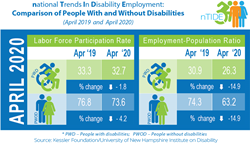
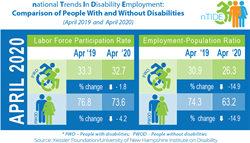
The employment-to-population ratio for working-age people with disabilities decreased from 30.9 percent in April 2019 to 26.3 percent in April 2020 (down 14.9 percent or 4.6 percentage points).

For working-age people without disabilities, the employment-to-population ratio also decreased from 74.3 percent in April 2019 to 63.2 percent in April 2020 (down 14.9 percent or 11.1 percentage points). The employment-to-population ratio, a key indicator, reflects the percentage of people who are working relative to the total population (the number of people working divided by the number of people in the total population multiplied by 100).

For working-age people without disabilities, the labor force participation rate decreased from 33.3 percent in April 2019 to 32.7 percent in April 2020 (down 1.8 percent or 0.6 percentage points). For working-age people without disabilities, the labor force participation rate also decreased from 76.8 percent in April 2019 to 73.6 percent in April 2020 (down 4.2 percent or 3.2 percentage points). The labor force participation rate is the percentage of the population that is working or actively looking for work.

In April 2020, among workers ages 16-64, the 3,827,000 workers with disabilities represented 3.1 percent of the total 124,631,000 workers in the U.S.

nTIDE Special Report – Friday May 15

Stay tuned for more on jobs as we follow the impact of COVID-19.

Beyond the Numbers

Finding a job and maintaining employment are challenges for everyone today, and people with disabilities who are striving to work face mounting challenges to reaching their goal of financial independence. Individuals with disabilities who are re-entering the community from jail or prison have even greater needs for comprehensive services and supports. The pandemic has promoted early release of inmates to reduce exposure in crowded facilities, increasing the need for vocational support for this population.

In Louisiana, which has the highest incarceration rate in the nation, efforts were already underway to improve employment outcomes and financial security of formerly incarcerated individuals with disabilities, with an ultimate goal of helping people remain in their communities. In 2019, with funding from the Greater New Orleans Foundation, JPMorgan Chase & Co., and Kessler Foundation, Disability Rights Louisiana launched the FAIR project (Financial Access Inclusion and Resources), in response to the state’s plans to reduce the prison population by 10%.        

FAIR enrolls individuals pending release from incarceration within 3 months, as well as those up to 10 years post release, assessing baseline goals, identifying barriers to employment, and creating an action plan with tasks and target dates. Financial coaching is the cornerstone of FAIR’s flexible and holistic program, which partners with the Justice and Accountability Center of Louisiana to address clients’ court fines and fees and draws on community resources for job training and placement, health care, legal services, housing assistance, and other services. As of March 2020, 61% of enrollees were actively participating, with 48% working, and a growing number increasing their incomes and reducing their debts, according to FAIR’s program director Libby Whiteside at Disability Rights Louisiana. The spread of COVID-19, however, prompted measures that triggered layoffs that affected FAIR’s clients, and complicated the coordination of community services.

“We are grateful to have this program up and running at a time like this,” says Whiteside, “when it is so important to help our clients access services and supports during this time, so they are positioned for employment opportunities moving forward.” Working remotely, Whiteside and case manager Pat Holmes have been able to continue to accept new clients and provide case management and financial coaching services. They find the most pressing current needs of their clients relate to accessing healthcare services, reporting wage changes to Social Security, and applying for income supports, including disability benefits, SNAP, unemployment assistance, and rental assistance.

Many of the career development providers that had assisted FAIR’s clients have suspended their employment services. ”For clients who are job-ready, we are helping them apply for high-demand opportunities,” says Whiteside, “while keeping in mind that many of our clients are considered to be in the high-risk category for coronavirus infection.”

Whiteside anticipates the need to be creative and pivot to find new opportunities to meet client needs. “We have participated in webinars hosted by National Disability Institute and APSE on how COVID-19 has impacted the disability community and on providing remote employment supports,” she reports, “and we are taking weekly courses from the Financial Clinic on financial coaching strategies in the face of COVID-19, as well as attending New Orleans Reentry Task Force and other meetings focused on the needs of people in reentry during this pandemic. Like many disability organizations,” she said in conclusion, “we are finding our way, seeking new ways to connect, building new relationships and improving our own capacity for finding job leads available to the population we serve.”

Ask Questions about Disability and Employment

Join our nTIDE Lunch & Learn series today, May 8, at 12:00 pm Eastern. This live broadcast, hosted via Zoom Webinar, offers attendees Q&A on the latest nTIDE findings, provides news and updates from the field, as well as invited panelists to discuss current disability-related findings and events. Libby Whiteside, program director for FAIR at Disability Rights Louisiana and case manager Pat Holmes join Dr. O’Neill, Dr. Houtenville, and Denise Rozell, Policy Strategist at AUCD. Join live or watch the recordings at: ResearchonDisability.org/nTIDE.

NOTE: The statistics in the nTIDE are based on Bureau of Labor Statistics numbers but are not identical. They are customized by UNH to combine the statistics for men and women of working age (16 to 64). nTIDE is funded, in part, by grants from the National Institute on Disability, Independent Living and Rehabilitation Research (NIDILRR) (90RT5037) and Kessler Foundation.

About Kessler Foundation

Kessler Foundation, a major nonprofit organization in the field of disability, is a global leader in rehabilitation research that seeks to improve cognition, mobility, and long-term outcomes — including employment — for people with neurological disabilities caused by diseases and injuries of the brain and spinal cord. Kessler Foundation leads the nation in funding innovative programs that expand opportunities for employment for people with disabilities. For more information, visit KesslerFoundation.org.

About the Institute on Disability at the University of New Hampshire

The Institute on Disability (IOD) at the University of New Hampshire (UNH) was established in 1987 to provide a coherent university-based focus for the improvement of knowledge, policies, and practices related to the lives of persons with disabilities and their families. For information on the NIDILRR-funded Employment Policy and Measurement Rehabilitation Research and Training Center, visit ResearchonDisability.org.

For more information, or to interview an expert, contact:

Carolann Murphy, 973.324.8382, CMurphy@KesslerFoundation.org.

Tips From The American Mosquito Control Association


While much of America is practicing some kind of social distancing in response to Covid-19 by staying home, remember that there are other harmful viruses in our environment. You can take steps right now at your own home to reduce the chance of catching mosquito-borne diseases during the upcoming warmer months of the year.

The American Mosquito Control Association (AMCA) is reminding everyone to eliminate standing water in neglected buckets, flowerpots, trash cans, and other containers that can develop mosquitoes which can carry West Nile virus, dengue, Eastern Equine Encephalitis and Zika viruses. According to the World Health Organization (WHO) and the Centers for Disease Control and Preventions (CDC), coronavirus cannot be transmitted by mosquitoes.

That’s why the AMCA recommends that while you are home, take the opportunity to check your yard and empty standing water sources to avoid making a place for mosquitoes to develop.

“With many Americans at home under stay-at-home orders, it is a good time to do some yard maintenance to prevent mosquitoes developing on your property,” says AMCA President Ary Faraji. “Not only do you get a chance to get out of the house, but by draining backyard water sources you make your yard safer in the coming months by eliminating mosquito development sites.”

Mosquitoes can develop in as little as a cap full of water and can become adults in less than a week.

West Nile virus transmitted by the bite of just one infected mosquito can cause serious illnesses such as meningitis and encephalitis. In 2019, 47 states and the District of Columbia reported West Nile virus infections in people, birds, or mosquitoes. Overall, 917 cases of West Nile virus disease in people were reported to the CDC last year. In addition to West Nile virus, there were 34 cases of Eastern Equine Encephalitis and 20 locally acquired infections of Dengue.

Below is a brief video describing the benefits of mosquito control and abatement to individuals, their homes and neighborhoods:https://www.mosquito.org/page/mosquitocontrol

Contact: Dave Brown, AMCA Technical Advisor, at dabrownsoj@gmail.com

The American Mosquito Control Association, founded in 1935, is a scientific/educational, not-for-profit public service association with members or subscribers to its publications throughout the United States and in over 50 countries. Our mission is to provide leadership, information, and education leading to the enhancement of health and quality of life through the suppression of mosquitoes and other vector-transmitted diseases. For more information, visit http://www.mosquito.org.

Share article on social media or email: