Category Archives: Health

What is new in the field of Health. Trending topics, and cutting edge research in the are of Health. Press Releases that give us updates on Health.

Trident at AIU Launches New Doctoral-Level Health Administration Program


Starting this April, Trident at American InterContinental University (Trident) will begin offering its new Doctor of Health Administration (DHA) program. This is Trident’s sixth doctoral-level program and second within its College of Health and Human Services.

The goal of this program is to help health administrators prepare to pursue opportunities in this growing field. Impacted by regulatory and legal policy, political and social trends, and technological innovations, the Bureau of Labor Statistics projects that employment of medical and health services manager will see growth of 18% from 2018 to 2028*.

Students in this online doctoral program will be taught to critically evaluate research, and the political, social, and legal climates of modern healthcare administration. Successful graduates will have an expert-level understanding of applied research, and an understanding of how this information can be used to effectively lead health organizations in ethical, social, legally, financially, and culturally responsible ways.

The DHA program culminates in a Doctoral Study Project that graduates must successfully defend. The project is a comprehensive study using applied research methods to investigate an area of healthcare administration that is of interest to the student.

Like other Trident programs, the DHA program is stackable. This allows graduates from Trident’s Master of Science in Health Administration (MSHA) or Master of Science in Health Sciences (MSHS) programs the option of applying up to 16 credits towards the DHA program. Students who have successfully obtained a health-related graduate degree from another regionally accredited institution may also be eligible to transfer up to 16 credits into this new program.

Courses that can be transferred into the DHA program include Health Care Finance, Health Care Law, Regulations, and Ethics, Healthcare Delivery Systems, and Health Equity.

Enrollment is now open for Trident’s Doctor of Health Administration program. Instruction begins on April 13.

About Trident at American InterContinental University

Founded in 1998, Trident at American InterContinental University (Trident at AIU) is part of an online postsecondary university serving adult learners. Trident at AIU uses the EdActive™ learning approach, which employs case-based learning in an online setting to teach real-world relevant critical thinking skills designed to enhance the lives and education of students. Trident offers quality associate, bachelor’s, master’s, and doctoral degree programs and certificates, led by a qualified faculty team, over 80% of whom have doctoral degrees. Trident at AIU is regionally accredited by the Higher Learning Commission (hlcommission.org) and has more than 22,000 alumni with a military affiliation. Trident has received acknowledgements from Washington Monthly, Military Times, and Military Advanced Education & Transition for their dedication to student success. Visit http://www.trident.edu or call at (855) 290-0290 to learn more about Trident at AIU’s wide range of educational options.

Share article on social media or email:

Mediaplanet and Voice Actor Rob Paulsen Team up in Promoting Good Oral Health


News Image

With topics ranging from the importance of starting a good oral care routine from a young age to how early detection of oral cancer can save your life, the campaign is a call to action urging people to advocate for their own oral health.

Kicking off April’s Oral Cancer awareness month, Mediaplanet launches its newest edition of the Oral Health campaign. The campaign is aimed at increasing awareness of the importance of oral health to overall health and wellbeing. With topics ranging from the importance of starting a good oral care routine from a young age to how early detection of oral cancer can save your life, the campaign is a call to action urging people to advocate for their own oral health.

According to the Academy of Pediatric Dentistry, 50 percent of children will have tooth decay by the age of five. By neglecting their oral health, many Americans face a number of oral health diseases that not only can result in partial to total tooth loss, infection, and even death, but also overall wellbeing and mental health. 85 percent of Americans believe that oral health is extremely important to their overall health (according to a Delta Dental), yet only half of those surveyed reported they visit the dentist at least one time per year. This discrepancy highlights the importance of raising awareness on these topics and educating people on best practices.

The print component of Oral Health is distributed within today’s edition of USA Today in New York, Chicago, D.C Baltimore, Los Angeles, Houston, Las Vegas, Pittsburgh/Cleveland, and Boston markets, with a circulation of approximately 200,000 copies and an estimated readership of 600,000. The digital component is distributed nationally, through a vast social media strategy, and across a network of top news sites and partner outlets. To explore the digital version of the campaign, visit: https://www.futureofpersonalhealth.com/campaign/oral-health/

Profiled in the cover story is Rob Paulsen, American voice actor and throat cancer survivor. As the 2020 spokesperson for the Head and Neck Cancer Alliance, Paulsen has been advocating to raise awareness of the disease and preventative measures. In an interview with Mediaplanet he shares his experience with throat cancer and his motivation behind his advocacy.

This campaign was made possible with the support of the Academy of General Dentistry, American Association of Endodontists, American Academy of Pediatric Dentistry, American Academy of Cosmetic Dentistry, Head and Neck Cancer Alliance, Operation Smile, America’s Toothfairy, SmartMouth, Native, and Blue Cross Blue Shield of Massachusetts.

About Mediaplanet

Mediaplanet specializes in the creation of content marketing campaigns covering a variety of industries. We tell meaningful stories that educate our audience and position our clients as solution providers. Our unique ability to pair the right leaders with the right readers, through the right platforms, has made Mediaplanet a global content marketing powerhouse. Our award-winning stories have won the hearts of countless readers while serving as a valuable platform for brands and their missions. Just call us storytellers with a purpose. Please visit http://www.mediaplanet.com for more on who we are and what we do.

Press Contact:

Nellie Dubin

Nellie.Dubin@mediaplanet.com

(646) 922-1412

Share article on social media or email:

Doctors without Jobs Calls for Activation of Unmatched Physicians in Coronavirus Pandemic


News Image

All unmatched U.S. doctors who graduated from U.S. medical schools in good standing should be given the opportunity to serve in communities throughout the country where they are most needed in this pandemic.

All unmatched U.S. doctors who graduated from U.S. medical schools in good standing should be given the opportunity to serve in communities throughout the country where they are most needed in this pandemic.

This month, more than 1,200 U.S. medical school seniors learned they did not match to a medical residency. In addition, an untold number of prior-year medical school graduates did not match to a residency. In fact, since 2011, each year a total of approximately 2,000 current-year grads and prior-year graduates haven’t matched.

After spending four years on an undergraduate education, those who enter medical school have gone through a highly competitive and rigorous process to get one of the limited number of seats available in U.S. medical schools. Those who commit eight years of their lives to a very specialized education have a reasonable expectation that they will be able to practice medicine. That a doctor has invested eight years of his or her life in an intellectually demanding field of study and is then shut out of the process is a tremendous violation of the social contract in America.

We call on President Donald Trump, Vice President Pence, Dr. Anthony Fauci, VP Pence’s coronavirus team, Surgeon General Dr. Jerome Adams, the AMA, The Match, the Accreditation Council for Graduate Medical Education, the Association of American Medical Colleges, the Association of American Physicians and Surgeons and the heads of U.S. medical colleges to work together to deploy those unmatched, and willing to serve. In turn for their commitment to serve for one year, we ask that they be given one-year residency equivalency.

For interviews, contact Maria Fotopoulos at 310.479.2002 or mfotopoulos@pfirdc.org, Los Angeles.

FB @doctorswithoutjobs

Twitter @DoctorsWithoutJobs

Share article on social media or email:

Domestic Gag Rule Reduces Birth Control Access For Almost 55,000 Women Living In Iowa


“Even before the domestic gag rule went in to place, more than 170,000 low-income women in Iowa lived in contraceptive deserts, which are counties without reasonable access to the full range of birth control methods,” said Ginny Ehrlich, CEO, Power to Decide.

Data released by Power to Decide estimate 54,210 women in Iowa of reproductive age (13-44) in need of publicly funded contraception live in counties losing federal funding for the Title X Family Planning Program as a result of the implementation of the “domestic gag rule.”

The domestic gag rule requires health providers receiving Title X funds to withhold information from patients about abortion services and care. In addition, health centers are required to cease providing abortion care with non-Title X funds at sites that offer Title X supported services, such as contraceptive care, breast and cervical cancer screening and STI testing. The rule requires that abortion services, no matter how they are funded, be performed at a separate physical site, which is impossible for many health centers.

“The implementation of the domestic gag rule could impact close to 55,000 Iowa women in need of birth control,” said Ginny Ehrlich, CEO, Power to Decide. “This federal rule exacerbates an already challenging contraceptive access landscape for women struggling to make ends meet. Even before the domestic gag rule went in to place, more than 170,000 low-income women in Iowa lived in contraceptive deserts, which are counties without reasonable access to the full range of birth control methods. As a result, these women face untenable barriers to access related to the costs of transportation, child care and taking unpaid time from work to get the contraception they need.”

Data from Power to Decide show that 173,100 women living at or below 250% of the poverty level in Iowa live in contraceptive deserts, counties in which there is not reasonable access to a health center offering the full range of contraceptive methods. Nationally, more than 19 million U.S. women of low income live in contraceptive deserts.

In this challenging landscape, states like Iowa can take proactive steps to partially alleviate the impact of damaging federal policies and to expand access to contraception in various ways. Iowa has already expanded Medicaid to low-income adults, which helps decrease the percentage of uninsured women, and by extension, gives them the contraceptive coverage they need to live healthy lives. In addition, other policies that would help include allowing pharmacists to prescribe contraception, requiring insurance to cover an extended supply of prescription contraceptives and enacting policies that protect insurance coverage of the full range of contraceptive methods. To further expand access, Iowa is currently considering legislation that would allow pharmacists to prescribe contraception and require insurance coverage for an extended supply of prescription contraceptives. More information about these policies can be found here.

Power to Decide is a private, non-partisan, non-profit organization that works to ensure all people—no matter who they are, where they live or what their economic status might be—have the power to decide if, when and under what circumstances to get pregnant and have a child. Please visit us at http://www.PowerToDecide.org or follow us on Facebook and Twitter.

Share article on social media or email:

1.2 Million Women In Florida Live In Contraceptive Deserts


“The domestic gag rule has led to a loss of funds to support vital health services, including contraceptive services in Hillsborough County, making it harder for an estimated 90,000 women in need to access contraceptive services and supplies,” said Ginny Ehrlich, CEO, Power to Decide.

According to data released by Power to Decide, an estimated 1,193,360 women living at or below 250% of the poverty level in Florida live in contraceptive deserts, counties in which there is not reasonable access to a health center offering the full range of contraceptive methods. Currently, across the country more than 19 million U.S. women of low income live in contraceptive deserts.

“Nearly 1.2 million women in Florida face tremendous barriers to accessing contraception they need and deserve,” said Ginny Ehrlich, CEO, Power to Decide. “This is unacceptable and stands in the way of these women’s power to decide if, when and under what circumstances to get pregnant and have a child. Because access to contraception is limited in many parts of Florida, women who are already struggling to make ends meet are burdened with additional costs to access basic health care. When the only clinics available to them are far from home, many of these women face untenable decisions, like whether to use their limited transportation dollars to get to work or to the clinic, how they will pay for extra child care hours and if they can afford to take time off work.”

Women in Florida are also far less likely to have health coverage than women in other parts of the country, which limits their ability to access reproductive health services, including contraceptive services. In Florida, 18% of women of reproductive age (13-44) are uninsured, as compared to 11.7% of their peers nationally.

“The implementation of the Title X Family Planning Program domestic gag rule made things even worse for women struggling to make ends meet in Florida. The domestic gag rule has led to a loss of funds to support vital health services, including contraceptive services in Hillsborough County, making it harder for an estimated 90,000 women in need to access contraceptive services and supplies,” said Ehrlich.

The domestic gag rule requires health providers receiving Title X funds to withhold information from patients about abortion services and care. In addition, health centers are required to cease providing abortion care with non-Title X funds at sites that offer Title X supported services, such as contraceptive care, breast and cervical cancer screening and STI testing. The rule requires that abortion services, no matter how they are funded, be performed at a separate physical site, which is impossible for many health centers.

In this challenging landscape, states like Florida can take proactive steps to partially alleviate the impact of damaging federal policies and to expand access to contraception in various ways. Expanding Medicaid to childless adults would help decrease the percentage of uninsured women, and by extension, give them contraceptive coverage. In addition, allowing pharmacists to prescribe contraception, and requiring insurance to cover an extended supply of prescription contraceptives can make it easier to access some contraceptive methods. Florida can also guard against additional barriers to access by enacting policies that protect insurance coverage of the full range of contraceptive methods. More information about these policies can be found here.

Power to Decide is a private, non-partisan, non-profit organization that works to ensure all people—no matter who they are, where they live or what their economic status might be—have the power to decide if, when and under what circumstances to get pregnant and have a child. Please visit us at http://www.PowerToDecide.org or follow us on Facebook and Twitter.

Share article on social media or email:

At Home With Your Kids? Perfect Time to Talk About the Risks of Underage Drinking and Drug Use


News Image

Studies show that parents are the leading influencers of their children’s decisions about whether or not to drink or use other drugs. We want to help parents with these sometimes uncomfortable conversations because they are so vitally important to preventing bad decisions that can lead to tragedy.”

With schools and extracurricular activities canceled around the nation and many adults working at home, Mothers Against Drunk Driving (MADD) and national presenting sponsor Nationwide are encouraging parents to take this extraordinary time of family togetherness to talk to their children about the risks of underage alcohol and drug use.

Every year, as part of MADD’s Power of Parents program, Spring is designated “PowerTalk 21” — a time for parents to initiate or revisit conversations about upcoming events where alcohol or drugs may be more prevalent. This year, MADD is expanding the online availability of PowerTalk 21, “Weed Out Fact from Fiction,” to reach the many families who are at home and social distancing. New research on the effects of marijuana use and teens, in addition to the well-known facts about the dangers of underage drinking, are featured in this year’s program.

“Traditionally, this has been a crucial time to start having conversations or to renew them. The spring months are filled with milestone events like spring break, prom and graduation, occasions that can increase the presence of alcohol and other drugs,” said MADD National President Helen Witty. “We recognize that many of these events have been canceled or could be canceled in the coming weeks. We also recognize that in time, our children and grandchildren will return to school. Local businesses will reopen. And the risks of underage alcohol and drug use will remain.”

Witty will provide a free, Facebook Live presentation of the latest research and tips for parents to start conversations with their underage children on Wednesday, April 1 at noon Eastern on MADD’s Facebook page @MADD.Official. The following week at the same time and location, Dr. Robert Turrisi, PhD, Penn State professor of Biobehavioral Health and Prevention Research Center, will discuss “Coping with Stress” during this challenging time and how that ties in to preventing underage drinking and drug use. He will return April 15 with a Q&A on new research about teen marijuana use. The series will continue every Wednesday at noon through April 29. Local MADD offices across the country, which typically hold in-person programs within their communities, will also host presentations via video conferencing to ensure parents are still able to access this crucial support. In addition, a free download of the Power of Parents Handbook for parents of middle school and high school students is available at http://www.madd.org/powerofparents.

“Studies show that parents are the leading influencers of their children’s decisions about whether or not to drink or use other drugs,” Witty said. “We want to help parents with these sometimes uncomfortable conversations because they are so vitally important to preventing bad decisions that can lead to tragedy.”

MADD is grateful to presenting sponsor Nationwide for supporting MADD’s mission to prevent the consequences of underage drinking and impaired driving.

“At Nationwide, we exist to protect people, businesses and futures with extraordinary care,” said Martha Frye, Senior Regional Vice President at Nationwide. “Part of being a trusted, caring and customer-focused protection company is educating young people on the dangers of underage drinking and drug use. We’re proud to continue to partner with MADD to equip parents and teenagers with the resources they need to have these critical conversations and to ultimately prevent senseless tragedies from occurring on our roadways.”

According to the Centers for Disease Control and Prevention (CDC), excessive drinking is responsible for more than 4,300 deaths among underage youth each year and can lead to early addiction as well as many other dangerous outcomes. In addition, marijuana is the leading cause of substance dependence other than alcohol in the United States.

According to new research, 1 in 3 middle school students have consumed marijuana by the time they finish middle school, and 1 in 8 middle school students reported consuming marijuana in the past month.

This new research also shows:


  • By the age of 20, approximately 50% of youth have used marijuana in their lifetime.
  • When recent marijuana use is examined, 1 in 5 reported using in the past month.
  • 1 in 3 youth who drink alcohol have also combined alcohol with marijuana. This combination resulted in 2 to 3 times more problems than when alcohol alone was consumed.

MADD’s Power of Parents program wants to help parents “weed out” fact from fiction. Some of the common myths about marijuana:

1) “Marijuana is safer than alcohol.”

  • Both are drugs and are associated with serious problems especially if used by those under the age of 21 while the brain and body are still in a rapid period of development.


2) “Marijuana makes me a better driver.” It is not safer to drive after marijuana consumption.

  • Studies have shown that, of seriously injured drivers admitted to trauma centers, more than 1 out of 4 tested positive for marijuana. In another study of fatally injured drivers, more than 1 in 10 tested positive for marijuana.


3) “You cannot get addicted to marijuana.”

  • Marijuana is currently the leading cause of substance dependence other than alcohol in the United States. Studies show that marijuana accounts for over 50 percent of the 7 million people aged 12 or older who are dependent on or abusing a drug.

For more information or to download free Power of Parents handbooks for parents of middle school and high school students, visit http://www.madd.org/powerofparents.

About Mothers Against Drunk Driving

Founded in 1980 by a mother whose daughter was killed by a drunk driver, Mothers Against Drunk Driving® (MADD) is the nation’s largest nonprofit working to end drunk driving, help fight drugged driving, support the victims of these violent crimes and prevent underage drinking. MADD has helped to save more than 390,000 lives, reduce drunk driving deaths by more than 50 percent and promote designating a non-drinking driver. MADD’s Campaign to Eliminate Drunk Driving® calls for law enforcement support, ignition interlocks for all offenders and advanced vehicle technology. MADD has provided supportive services to nearly one million drunk and drugged driving victims and survivors at no charge through local victim advocates and the 24-Hour Victim Help Line 1-877-MADD-HELP. Visit http://www.madd.org or call 1-877-ASK-MADD.

About Nationwide®

Nationwide, a Fortune 100 company based in Columbus, Ohio, is one of the largest and strongest diversified insurance and financial services organizations in the United States. Nationwide is rated A+ by both A.M. Best and Standard & Poor’s. An industry leader in driving customer-focused innovation, Nationwide provides a full range of insurance and financial services products including auto, business, homeowners, farm and life insurance; public and private sector retirement plans, annuities and mutual funds; excess & surplus, specialty and surety; pet, motorcycle and boat insurance. For more information, visit http://www.nationwide.com . Follow us on Facebook and Twitter.


Share article on social media or email:

Expert Dentists Can Help Patients Remotely to Distinguish Emergencies from Less Urgent Matters, says Dr. Sahar Verdi of Dental Specialists of California


Sahar Verdi, D.D.S.

If people do need to come it for an emergency treatment, they should rest easy that we always take every possible step to prevent the transmission of microbes.

A March 20 article on CDA provides the California Dental Association’s updated recommendations for dental treatments. The primary recommendation is that treatment should be restricted to emergency care until further notice. Board-certified periodontist Sahar Verdi, D.D.S. of Dental Specialists of California, says that the seriousness of the COVID-19/coronavirus crisis fully justifies this step. At the same time, people with dental or oral health issues should not hesitate to get in touch electronically with an oral health care specialist.

“Emergencies don’t always announce themselves clearly. People with extreme pain, of course, will usually seek out care immediately but other symptoms might make patients wonder whether or not their situation is truly urgent,” Dr. Verdi said. “As a board-certified periodontist and a specialist in multiple areas, I regularly deal with the most serious oral healthcare issues. The worst tooth problems usually impact or start in the gums, and serious gum issues can very often require the removal of one or more teeth – a poor outcome which is even worse than most people think it is,” Dr. Verdi added.

“People should even consider reaching out with what they see as fairly mild symptoms. Relatively moderate but very persistent pain is always cause for at least some concern. Also, bad breath that doesn’t go away is a common sign of gum disease,” said Dr. Verdi. “It might not seem like the worst symptom in a time of social distancing, but it is it a red flag that needs to at least be discussed. The same goes for bleeding gums – even a somewhat pink toothbrush shouldn’t be ignored,” said Dr. Verdi.

“I offer virtual consultations where I can talk with patients and often look at photos they’ve taken of their mouths. That way I can at least provide them with peace of mind if their issue is not so urgent,” says Dr. Verdi. “On the other hand, if things look more serious, then we can make arrangements to deal with that,” she says.

“If people do need to come it for an emergency treatment,” says Dr. Verdi, “they should rest easy that we always take every possible step to prevent the transmission of microbes. That’s for the benefit of both the patient and ourselves. During the crisis, of course, we will take additional steps to ensure that there is as little contact between patients and our teams as we can possibly manage,” Dr. Verdi added.

“At a time like this, it’s more important than ever for everyone to practice outstanding oral hygiene including brushing and flossing at least two times every day. To kill any viruses that may be in a person’s mouth, I suggest either dissolving a teaspoon of salt in a cup [eight ounces] of water or making a 50/50 solution of water and hydrogen peroxide and rinsing with either for 20 seconds,” Dr. Verdi added.

“Finally, even if people have concerns they know for a fact aren’t emergencies but want to get an early start, they are very welcome to give us a call. No one knows when the crisis will end but, whenever that is, there is going to be a rush of people who’ve been putting of all kinds of issues, it never hurts to start things early,” concludes Dr. Verdi.

Readers who are interested in learning more about Dr. Verdi’s services in Thousand Oaks are invited to call 805-370-7171. They can also visit the Dental Specialists of California website at https://dentalspecialistsofca.com/. Los Angeles residents may wish to call the number for her West L.A. offices, (310) 477-1691.

Share article on social media or email:

Domestic Gag Rule Reduces Contraceptive Access For Nearly 80,000 Women Living In Maine


“Access for almost all women who are living at or below 250% of the poverty level in Maine has been impacted by the implementation of the domestic gag rule,” said Ginny Ehrlich, CEO, Power to Decide.

According to data released by Power to Decide, nearly all (98.8%) of Maine women of reproductive age (13-44) in need of publicly funded contraception have been impacted by the implementation of the Title X Family Planning Program “domestic gag rule.” Fifteen of 16 of Maine’s counties have lost some or all of their Title X resources to support vital health services leaving an estimated 79,700 women with less access.

The domestic gag rule requires health providers receiving Title X funds to withhold information from patients about abortion services and care. In addition, health centers are required to cease providing abortion care with non-Title X funds at sites that offer Title X supported services, such as contraceptive care, breast and cervical cancer screening and STI testing. The rule requires that abortion services, no matter how they are funded, be performed at a separate physical site, which is impossible for many health centers.

“Access for almost all women who are living at or below 250% of the poverty level in Maine has been impacted by the implementation of the domestic gag rule,” said Ginny Ehrlich, CEO, Power to Decide. “The domestic gag rule exacerbates an already challenging contraceptive access landscape for women struggling to make ends meet. These women face untenable decisions about how they will use already limited dollars to pay for transportation and child care costs to get to a clinic just to get the contraception they need.”

Data from Power to Decide show that 52,630 women living at or below 250% of the poverty level in Maine live in contraceptive deserts, counties in which there is not reasonable access to a health center offering the full range of contraceptive methods. Nationally, more than 19 million U.S. women of low income live in contraceptive deserts.

In this challenging landscape, states like Maine can take proactive steps to partially alleviate the impact of damaging federal policies and to expand access to contraception in various ways. Maine has already expanded Medicaid to low-income adults, which helps decrease the percentage of uninsured women, and by extension, give them contraceptive coverage they need to live healthy lives. In addition, Maine requires insurance to cover an extended supply of prescription contraceptives and has enacted policy that protects insurance coverage of the full range of contraceptive methods. To further expand access, Maine could allow pharmacists to prescribe contraception. More information about these policies can be found here.

Power to Decide is a private, non-partisan, non-profit organization that works to ensure all people—no matter who they are, where they live or what their economic status might be—have the power to decide if, when and under what circumstances to get pregnant and have a child. Please visit us at http://www.PowerToDecide.org or follow us on Facebook and Twitter.

Share article on social media or email:

Memphis-Based Poplar Healthcare Processing COVID-19 Tests


News Image

We are routinely providing results in 24 to 48 hours from receipt of the specimen.

Poplar Healthcare, a leading anatomic and molecular pathology laboratory headquartered in Memphis, TN, announced today that it is now processing COVID-19 tests in its 113,000-square-foot, high-complexity CLIA-certified and CAP-accredited laboratory in Memphis, Tennessee. Testing is performed on the cobas® SARS-CoV-2 Test via the cobas 6800 System which received Emergency Use Authorization from the Food and Drug Administration (FDA) on March 13, 2020. In addition, Poplar Healthcare is performing testing on the Roche cobas z480 analyzer and has submitted for Emergency Use Authorization (EUA) from the FDA.

“As coronavirus spreads across the nation at an alarming rate, Poplar Healthcare is well situated to help control the outbreak by providing patients and providers access to COVID-19 testing,” stated Poplar Healthcare Medical Director, Shawn Kinsey, MD. “Our proximity to FedEx allows our laboratory to not only service the city of Memphis and surrounding communities, but anywhere FedEx flies. We are routinely providing results in 24 to 48 hours from receipt of the specimen.”

Poplar Healthcare’s Vice President of Genomic Operations and Development, Anami Patel, PhD, commented, “Providing testing on different platforms allows the laboratory flexibility to adapt to challenges in the supply chain and provides additional capacity to serve patients and healthcare workers who need the testing the most.”

Poplar Healthcare is one of the largest physician-owned pathology group practices in the United States, offering a wide variety of DNA- and RNA-based molecular tests. It receives thousands of samples each day and is supported by a team of over 25 board-certified and fellowship-trained pathologists.

Healthcare providers and institutions interested in obtaining access to the test can contact Poplar Healthcare at 901-526-1912 or email covid19@poplarhealthcare.com.

About Poplar Healthcare

Founded in 1995 and headquartered in Memphis, Tennessee, Poplar Healthcare is a leading laboratory services company. Through its GI Pathology, Bostwick Laboratories, D-PATH, OncoMetrix and Women’s Health Laboratories brands, Poplar Healthcare provides specialized laboratory testing services to a nationwide client base of gastroenterologists, dermatologists, oncologists, urologists, gynecologists and their patients.

For more information, visit poplarhealthcare.com or micropathid.info.

Share article on social media or email:

Americans’ Confidence in Their Financial Health is Badly Shaken by COVID-19 Public Health Crisis


News Image

We are experiencing a historic economic event brought on by this global pandemic. Americans need immediate financial assistance and support to get their households and families through this crisis.

Americans are feeling the economic pain of the global COVID-19 pandemic, and their confidence in the U.S. economy has been badly shaken, according to a new poll by American Consumer Credit Counseling.

The ACCC Financial Health Index found nearly 80 percent of those surveyed have been impacted by the shutdown of entire economic sectors and other effects from the spread of the novel Coronavirus to more than 740,000 people worldwide, and over 140,000 in the U.S. alone. COVID-19 has claimed over 35,000 lives around the globe.

“Our Financial Health Index was created to measure how Americans are feeling about their household finances as well as the overall U.S. economy. As we find ourselves amid an unprecedented crisis, the picture right now is bleak,” said Steve Trumble, President and CEO of American Consumer Credit Counseling. “Income security, financial stability, and household debt levels are all major pressing issues on the minds of American consumers.”

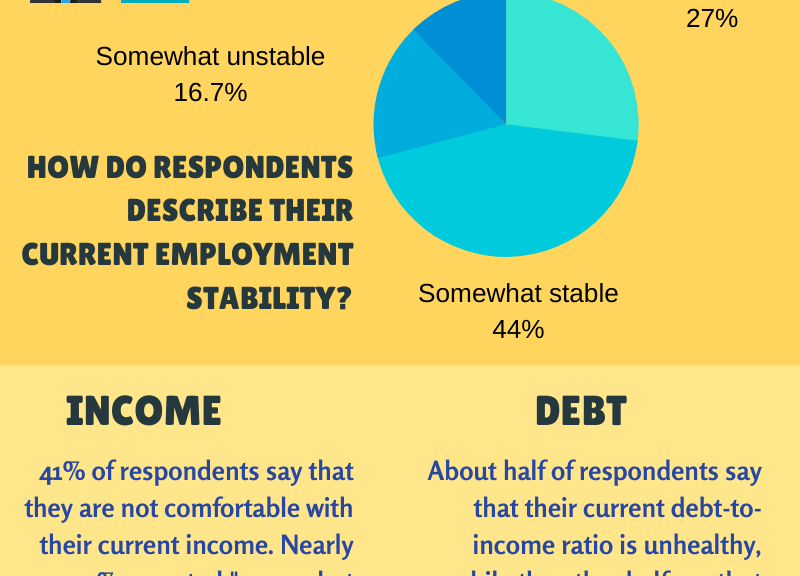
The poll of 430 Americans – aged 25-65 with incomes of $100,000 or less – found that 29 percent have been “significantly impacted” financially by COVID-19, while close to 50 percent have been at least “somewhat impacted.”

Additionally, a combined 55 percent of those polled said they were either “not so confident” or “not confident at all” in the U.S. economy right now. In comparison, just 13 percent reported being “very confident.” Forty-one percent of respondents said they were “uncomfortable” in some way with their current household income, and 40 percent lack confidence in their ability to reduce their household debt by at least 10 percent over the next six months.

The ACCC Financial Health Index poll has a margin of error of plus-or-minus 6 percent. (An infographic is attached below depicting select results.)

A record 3.3 million Americans filed for unemployment benefits in the past week, according to the Labor Department – more than four times the prior historical peak of 695,000 unemployment claims during one week in 1982. Thousands of businesses have been shuttered nationwide as a result of quarantines, stay-at-home orders, social distancing measures, and the resulting plummet in demand for almost anything not considered essential goods or services. Lawmakers in Washington have approved a $2 trillion economic stimulus and relief package to try and shore up the economy as the U.S. grapples with COVID-19 and tries to control the rapid pace of infection.

Those who are in the most-dire circumstances responded in smaller, but not insignificant, numbers. The poll found 12 percent consider their current employment “very unstable,” 16 percent have lost all confidence in the U.S. economy, and 16 percent have almost no ability to pay down debt.

“We are experiencing a historic economic event brought on by this global pandemic. Americans need immediate financial assistance and support to get their households and families through this crisis,” Trumble said. “They will also require budget counseling, assistance from creditors through forbearance and payment deferral, and flexibility from mortgage banks and landlords on housing payments.”

Some positive findings: The Financial Health Index found 70 percent of respondents consider their current employment “stable,” and 60 percent still feel confident in their prospects for continued employment six months from now. The poll also found 52 percent feel their debt-to-income ratio is either “somewhat healthy” or “very healthy,” with 60 percent still in a position to pay down debt.

Financial counselors at ACCC continue to provide callers with budget counseling and assistance with creditors, while providing further assistance through ConsumerCredit.com and the ACCC Talking Cents blog. Counselors are also directing clients to resources such as the Ready.gov section on financial preparedness, and the downloadable EFFAK (Emergency Financial First Aid Kit) guide.

About American Consumer Credit Counseling

American Consumer Credit Counseling (ACCC) is a nonprofit credit counseling 501(c)(3) organization dedicated to empowering consumers to achieve financial management through credit counseling, debt management, bankruptcy counseling, housing counseling, student loan counseling, and financial education concerning debt solutions. To help consumers reach their goal of debt relief, ACCC provides a range of free consumer personal finance resources on a variety of topics including budgeting, credit and debt management, student loan assistance, youth and money, homeownership, identity theft, senior living, and retirement. Consumers can use ACCC’s worksheets, videos, calculators, and blog articles to make the best possible decisions regarding their financial future. ACCC holds an A+ rating with the Better Business Bureau and is a member of the National Foundation for Credit Counseling® (NFCC®). For more information or to access free financial education resources, log on to ConsumerCredit.com or visit http://www.consumercredit.com/financial-education.aspx

Share article on social media or email: