Category Archives: Health

What is new in the field of Health. Trending topics, and cutting edge research in the are of Health. Press Releases that give us updates on Health.

The National Association of Locum Tenens Organizations® (NALTO®) Leads Healthcare Staffing Industry in Honoring Locum Tenens Physicians for National Locum Tenens Week


The National Association of Locum Tenens Organizations® (NALTO®) is leading healthcare staffing agencies in honoring locum tenens providers as part of this week’s fourth annual National Locum Tenens Week celebration.

“National Locum Tenens Week is the time when we reflect on and honor the incredible work locum tenens clinicians do every day,” says NALTO® President Matt Erickson.

Unlike previous years, staffing firms will acknowledge the impact of locum tenens physicians on fighting the COVID-19 crisis in 2020.

“This year, the week takes on new significance as we reflect on the way so many locum tenens clinicians selflessly traveled to the places across the country hit hardest by the pandemic to serve on the front lines of the COVID crisis. The impact they’ve had on the patients in their care is tremendous,” says Erickson.

It’s estimated that ninety percent of U.S. hospitals use locum tenens physicians, highlighting the continued rise in demand for temporary staffing solutions.

National Locum Tenens Week occurs annually the second week in August. Led by the National Association of Locum Tenens Organizations® (NALTO®), the program’s annual platform provides a forum to collectively recognize locum tenens doctors and the contributions made by staffing agencies to the U.S. healthcare industry.

To learn more about National Locum Tenens Week and download the official marketing toolkit, please visit https://www.nalto.org/national-locum-tenens-week.

Follow #locumtenensweek on social media to see how locum tenens staffing agencies are celebrating temporary providers and sharing stories of their impact on the medical industry.

About NALTO®: The National Association of Locum Tenens Organizations® (NALTO®) is the only professional association of temporary physician staffing firms committed to a code of ethics and to maintaining the highest industry standards.

Contact:

Dawn McKnight, Executive Director

National Association of Locum Tenens Organizations® (NALTO®)

(407) 774-7880

info@nalto.org

Share article on social media or email:

Coverage of International Society for Magnetic Resonance in Medicine (ISMRM) virtual meeting featured on AuntMinnie.com


AuntMinnie.com logo

We’re pleased to once again be offering coverage of the ISMRM annual meeting. This year’s virtual format for ISMRM 2020 is a perfect complement to our exclusively online coverage.

For the second straight year, radiology portal AuntMinnie.com, part of Science and Medicine Group, has launched a new special section dedicated exclusively to the proceedings of the International Society for Magnetic Resonance in Medicine (ISMRM) annual meeting.

AuntMinnie’s RADCast@ISMRM is available at radcast.auntminnie.com and features wall-to-wall editorial coverage of the premier medical conference dedicated exclusively to MRI. Important topics at the 2020 conference include the following:

  • Alternatives to gadolinium-based MRI contrast
  • Reducing the ecological impact of MRI scanners
  • MRI in low-resource countries
  • New applications of artificial intelligence and MRI
  • Holographic visualization of human anatomy
  • Efforts to improve the safety of MRI scanning

“We’re pleased to once again be offering coverage of the ISMRM annual meeting,” said Brian Casey, editor in chief of AuntMinnie.com. “This year’s virtual format for ISMRM 2020 is a perfect complement to our exclusively online coverage.”

ISMRM’s mission to educate the MRI community continues with this year’s virtual meeting, even in an era of social distancing, according to Lawrence L. Wald, PhD, 2019-2020 ISMRM president.

“Sharing research, networking, precipitating new thinking, and inspiring thought that does not come easily in isolation — that is the goal of our annual meeting,” Wald said. “It’s been a challenging year for all of us, with plenty of isolation, but I am confident that the virtual meeting can achieve these goals. I look forward to participating in it with you. It has been an honor serving the society as the 2019-2020 ISMRM president.”

AuntMinnie’s daily editorial coverage of ISMRM 2020 will run from August 8 to August 14.

About AuntMinnie.com

AuntMinnie.com is the premier online destination for radiologists, radiation therapists, interventional radiologists, and related professionals in the medical imaging industry, while AuntMinnieEurope.com serves the European radiology community. AuntMinnie.com and AuntMinnieEurope.com feature the latest news, communities, continuing medical education, and board review education for medical imaging physicians, clinicians, residents, and medical students across the world. AuntMinnie.com and AuntMinnieEurope.com are part of Science and Medicine Group.

Share article on social media or email:

Hoggan Scientific Provides Business Update Related to COVID-19


For over 20 years, Hoggan Scientific has been supporting the needs of its clients in the global medical and ergonomic communities with its evaluation and testing products. During these unprecedented times and challenges brought on by the coronavirus pandemic, Hoggan Scientific has implemented steps and taken precautionary measures to keep staff safe, with the health and safety of its employees as its top priority.

With employee safety measures in place, and updated production manufacturing planning to maintain business continuity, Hoggan Scientific has continued to be fully operational to be able to provide its customers excellent service, sales, and support. The company is at full capacity, and is fully staffed in all departments. The staff is ready and happy to serve to meet the needs of its customers.

Along with its medical and ergonomics product lines, Hoggan has added disposable face masks that are in line with FDA guidelines that are available. The addition of masks offers an easy sourcing option for customers if the need arises.

Hoggan Scientific products are used in hospitals, physical therapy clinics, sports and athletic facilities, universities, and automotive, manufacturing, aerospace, warehousing industries worldwide. For more information visit the website at http://www.hogganscientific.com, contact by phone at 800-678-7888/801-572-6500, or email at sales@hogganscientific.com. The manufacturer can also be found on Facebook at http://www.facebook.com/HogganScientific.

Share article on social media or email:

New England College of Optometry names first Diversity and Inclusion Liaison, Joins the 13% Promise


A head and shoulder photograph of Dr. Angela Abraham.

Angela Abraham, OD, Diversity and Inclusion Liaison

“This is about more than changing a culture,” said Dr. Abraham. “It’s about bringing ideas in from the outside to cross-pollinate and spur new thinking. I believe in the year 2020, we all see the need to come together with better ideas and bigger hearts, and share both for the greater good.”

Dr. Angela Abraham has been appointed as the first-ever Diversity and Inclusion Liaison for the New England College of Optometry (NECO). Dr. Abraham will be leading the drive to foster a more equitable and bias-free NECO community.

In a related announcement, NECO has also signed on to the 13% Promise, a new initiative led by Black Eyecare Perspective and dedicated to increasing Black presence in vision care. Both steps are part of a larger initiative for change at NECO, according to Howard Purcell, OD, the college’s President and CEO.

“NECO is eager to do its part to help create the more diverse and inclusive community that we all know is the future of vision care, and Dr. Abraham’s appointment is the first action in a larger plan,” President Purcell says. “Angela Abraham has been on faculty at NECO since 2011, and in her we have someone who has always been passionate about mentoring students of color in our field. She’s going to be essential in helping us achieve greater inclusion and living up to the ideals of the 13% Promise. This will take reflection and hard work, and we’re committed to a sustainable and powerful effort to get there.”

Dr. Abraham will work with NECO’s new Alliance for the Advancement of Diversity and Inclusion, which includes faculty, staff and students. The group’s goal is to promote a culture where individuals from diverse backgrounds and life experience feel they belong, are able to contribute, and can thrive academically and professionally. A primary role of this Alliance is to connect D&I activities to a broader set of data-driven, results-oriented strategies, and to promote campus-wide communication on progress.

“This is about more than changing a culture,” said Dr. Abraham. “It’s about bringing ideas in from the outside to cross-pollinate and spur new thinking. I believe in the year 2020, we all see the need to come together with better ideas and bigger hearts, and share both for the greater good.”

Dr. Abraham completed her Doctor of Optometry at the University of Missouri-St. Louis School of Optometry and took a Fellowship in Ocular Disease at the O’Donnell Eye Institute, St. Louis. Her undergraduate degree in Biology was at Smith College in Northampton, MA. During her time at Smith, Dr. Abraham was part of a NECO summer program designed to attract more individuals of color to optometry. Years later, she sees her new role as the chance to do the same for others.

“I’m excited about taking on this new role,” said Dr. Abraham. “We all know that it’s a long road to real inclusion and diversity, and I’m really happy to be part of that journey. I know NECO, and I know my colleagues and students are devoted to taking this important next step in optometry education.”

NECO joins the 13% Promise initiative by Black Eyecare Perspective

NECO recently signed on to the 13% Promise pledge led by Black Eyecare Perspective (BEP). The initiative — based on U.S. Census data showing that 13.4% of the U.S. population identifies as Black — is asking for an equal amount of Black representation in eye care companies, colleges of optometry and boards of trustees.

BEP will be working with NECO, and with others who join the pledge, to help reach the 13% goal. That includes providing both resources and accountability to help achieve targeted goals.

“Currently only 3.1% of NECO students and 4% of faculty identify as African American or Black, so the college will need a clear strategy to achieve this goal, says Traci Logan, Executive Vice President. “Increasing representation isn’t something we should just talk about as an aspiration, it has to become something we commit ourselves to doing because it benefits our students, employees, patients, and the eye care industry as a whole.”

NECO is also dedicated to sharing what it learns with other optometry schools, and to understanding what others have done. Says Logan, “We’ll be seeking best practices and knowledge from other schools and our industry collaborators to stimulate enduring success. These actions represent one step forward in a much longer journey, one we believe has the potential to transform the profession. Or, as we proudly state in our mission, we will change the way people see the world.”

Share article on social media or email:

Enara Health Names Lydia Alexander, MD, as Chief Medical Officer


Enara Health has developed an amazing patient-first system, and I’m particularly impressed by how the company has cracked the code on not just weight loss, but helping patients to maintain weight loss over time.

Enara Health, a technology-powered personalized weight loss program focused on sustainable results, today announced that Lydia C. Alexander, MD, has joined the company in the newly created position of Chief Medical Officer. A seasoned obesity medicine specialist, Dr. Alexander will play a vital role in expanding Enara Health’s national network of clinicians and fine-tuning the program’s clinical approach and technology platform to ensure continued comprehensive, personalized obesity treatment for patients across the country.

“Dr. Alexander represents an incredible addition to our team at an important time of growth and expansion,” said Dr. Rami Bailony, Co-Founder and CEO of Enara Health. “Her deep expertise as a practitioner in the field of obesity and her continued work with the Obesity Medicine Association (OMA) give her not only exceptional insight into the clinical side of treating patients, but also a strong national network of medical providers across the country. The combined power of her knowledge and connections is precisely what Enara Health needs as we continue to roll out our unique program and technology to new partners nationally.”

Dr. Alexander is board-certified in internal medicine, obesity medicine and lifestyle medicine, and is in the process of obtaining a certification as a culinary medicine specialist. Most recently working as a physician and obesity medicine specialist at Kaiser Permanente, she has nearly a decade of experience managing high-risk adults requiring physician-supervised medical weight management to improve diabetes, blood pressure, lipid profile, mobility and overall health.

“Enara Health has developed an amazing patient-first system, and I’m particularly impressed by how the company has cracked the code on not just weight loss, but helping patients to maintain weight loss over time,” said Dr. Alexander. “Enara’s platform is a living entity that continues to learn, and I’m excited by the opportunity to help refine the algorithm in a way that provides personalized, effective care to a growing base of patients nationwide.”

Dr. Alexander joined the OMA Board of Trustees in September 2017 and was elected as secretary/treasurer in September 2019. As part of her mission to advance the field of obesity medicine, deliver evidence-based treatments and improve the lives of patients affected by obesity, she often participates in general and continuing medical education lectures and podcasts on obesity medicine. She received the Dr. Raymond E. Dietz Meritorious Service Award in 2019 and the OMA Clinician of the Year award in 2018.

Residents across California, Texas and Illinois can now enroll in the Enara Health program. Learn more at http://www.enarahealth.com.

About Enara Health

Enara Health is building a data-driven platform and network to scale obesity treatment. Based in San Mateo, Calif., and operating since March 2015, Enara Health offers unique hybrid digital and in-person weight loss programs based on precision medicine. By combining mobile technology with health care visits and providing patients with personalized physician-driven medical weight loss programs, Enara Health routinely helps patients lose—and keep off—more than 15% of their baseline weight, which is far greater than the results seen with other e-health and m-health interventions. Learn more at http://www.enarahealth.com.

Share article on social media or email:

Lumacuity Led and lumablue Led announce new antibacterial led lighting, Lumablue


Lumacuity LED and Lumablue LED announce new antibacterial LED lighting, Lumablue.

LumaBlue LED lighting helps protect restaurants, grocery stores, salons, gyms, manufacturing facilities, homes and more against bacteria, mold, mildew and fungi growth.

Lumacuity LED has announced the the newest line of LED lights and fixtures.The line is called LumaBlue and is a series of blue light LED technology units. The latest offering is a 120-watt portable unit uniquely designed to meet the cleanliness and disinfectant needs of hair salons, gyms, retail and other commercial and residential markets. LumaBlue was recently featured in DBusines magazine.

“LumaBlue is centered on maintaining the highest degree of safety and cleanliness, and now we’re proud to be able to present it to the masses in an easy-to-use format,” said Len Smith, President, Lumacuity LED.

Serving a wide variety of markets

LumaBlue’s new 120-watt system can be used as a hanging anti-germicidal lamp or as a floor-based tripod that can easily be maneuvered throughout a facility. Each unit disinfects approximately 25’ x 25’ area over a three-hour period. They can be used as long as needed, but three hours is usually sufficient. They’re ideal solutions for disinfecting a variety of markets:

  • Restaurants
  • Deli’s/Bakeries
  • Grocery stores
  • Fitness centers and gyms
  • Medical and dental facilities
  • Nursing homes
  • Hair salons
  • Schools
  • Manufacturing facilities
  • Meat processing plants
  • Residential

LumaBlue began as a resource for first responders and healthcare frontline workers, many of whom are commonly exposed to harmful bacteria such as MRSA/Staph, Strep, Salmonella, mold, Listeria and more. A study from Children’s Hospital Los Angeles suggests MRSA can survive on some nonporous surfaces up to eight weeks following contamination —and skin transmission takes only three seconds.

“Even after traditional cleaning methods, dangerous bacteria have been shown to linger throughout the nooks and crannies of many firehouses, EMS vehicles, hospitals—even on oxygen tanks and brake pedals,” said Smith.

Product Availability

All LumaBlue products—including the new portable 120W unit— are currently available for purchase at http://www.LumaBlueled.com.

LumaBlue is driven by customer feedback with a strong commitment to deliver the latest products in one convenient installation. All LumaBlue products—including the new portable 120W unit— are available for immediate purchase at http://www.lumablueled.com

Founded in 2013, Lumacuity LED services manufacturing facilities, warehouses, restaurants, schools, consumer goods and retail businesses with LED lighting design, product and installation. Lumcuity has developed strategies and partnerships with several of the top electrical firms and is recognized by DTE Energy as a Preferred Trade Ally and can arrange financing through ‘Michigan Saves.”

For more info, visit http://www.Lumablueled.com

Contact: Mike Fossano

Email: mfossano@premiercg.com

Share article on social media or email:

“Behind The Scenes” With Laurence Fishburne Discusses the Blueprint for Active Aging in Senior Living Communities with national provider Symbria


Senior Living communities have significantly evolved from where they were even 20 or 30 years ago

Symbria Inc. is pleased to announce that it is being featured in a nationally distributed television program, Behind the Scenes with Laurence Fishburne. Behind The Scenes is known for providing factual, unbiased information and specializes in mining the imaginative and exciting ideas that can benefit its viewers. Symbria’s segment focuses on embracing physical fitness and falls prevention as a means to address shifting expectations and mindsets towards aging.

“We’re thrilled to partner with Behind the Scenes to help educate our aging population and their families, about the variety of choices that are available to as they explore their living options,” said Jill Krueger, Symbria’s President and CEO. Ms. Krueger continued “Senior Living communities have significantly evolved from where they were even 20 or 30 years ago and are much better equipped to cater to the current needs and desires of their residents. This includes the necessity to have programs that address the physical and mental well-being that will enable residents to reach their one of their primary goals – to remain independent as long as possible.”

The show will launch its national airing during prime time on Fox Business Network followed by regional airings on various networks in more than 100 markets across the country. Additionally, the episode will be distributed to Public Television affiliates for airing later in August.

About Behind the Scenes

Behind the Scenes is an award-winning program that highlights new ideas and innovative concepts through groundbreaking short-form and long-form documentary presentation. The program, which is anchored by a veteran production team with decades of industry experience, is able to effectively communicate the most critical stories to a wide and diverse audience. The Behind the Scenes team specializes in mining the imaginative and exciting ideas that can benefit the public education domain. Additional information about Behind the Scenes can be found at https://behindthesceneslf.com/.

About Symbria, Inc.

Symbria Inc. provides best-in-class pharmacy, rehab, and well-being programs along with ancillary resources and tools to benefit post-acute and senior living providers, and their patients and residents. Symbria develops focused solutions for our clients’ challenges that reduce hospital readmissions, build census and extend independence for those they serve. Additional information about Symbria can be found at https://Symbria.com/.

Share article on social media or email:

Protect My Car explains how to keep your car clean during the COVID pandemic


Cleaning car during COVID

KEEPING YOUR CAR CLEAN DURING THE CORONAVIRUS OUTBREAK

By now, we all know that there are two good ways to fight COVID-19. One is to wash your hands for at least 20 seconds with plenty of soap and warm water.

The other is to disinfect high touch surfaces, according to the CDC.

When we think of high touch surfaces, things like door handles, your phone, and remote controls might come to mind.

But what about your car?

While you might not think of your car as you think of the door handle, chances are it’s just as gross.

According to a recent study by CarRentals.com – your car’s steering wheel plays host to over 6x the bacteria of your phone, and nearly double that of the typical elevator button.

Normally, that’s gross enough on its own, but considering the ongoing Coronavirus pandemic, it’s even more concerning than usual.

If for some reason you’re still driving your car, then it certainly can’t hurt to disinfect your car’s high touch surfaces including:


  • Steering wheel
  • Door handles
  • Shift levers
  • Buttons and touch screens
  • Wiper and turn signal levers
  • Armrests
  • Grab handles
  • Seat adjusters
  • Cupholders
  • Sunglass holders
  • Seat
  • Dashboards/molding

This is a must if you’re a rideshare driver or live in an area with a high concentration of cases. It’s worth doing even if you don’t, considering how dirty your car can get.

With that in mind – the CDC recommends daily disinfection of high touch surfaces, including your car.

Whether that’s something you want to take in stride or not – if you’re using your car, you should attempt to disinfect it at least 2-3 times a week.

The peace of mind is worth it, right?

Cleaning your car’s surfaces is a little bit different than cleaning your countertops. Bleach or hydrogen peroxide, for instance, will both kill the Coronavirus, but they’ll also leave your car’s interior looking less than ideal.

For example, bleach (or any bleach-based cleaner) will destroy the color of your car’s upholstery if you use it.

The same goes for hydrogen peroxide.

Ammonia and alcohol-based cleaners, on the other hand, can damage your touch screens and other electronics.

As you can see, cleaning your car is not as simple as you would think.

Besides just bleach and hydrogen peroxide, there are several other cleaners commonly associated with disinfecting you want to avoid as well.

These disinfectants can either damage your interior or are not proven to kill the Coronavirus, according to the CDC guidelines.

  • Acetone
  • Steam
  • Listerine
  • Vinegar
  • Essential Oils
  • Lemons

Although these may work for other bacteria, you should not use them to clean your car for any reason. For a complete list of disinfectants, please visit the CDC’s master list.

Before You Clean Your Car

Disinfecting your car should always start with you protecting yourself. We highly recommend you wear rubber gloves that are separate from your dishwashing gloves if possible.

Wearing a separate pair of gloves will help keep your hands clean, and help you avoid spreading anything from outside.

After you finish disinfecting your car, you should also make sure you wash your hands per the recommended CDC method.

Cleaning Non-Leather, Hard Surfaces (Metal, Plastic, and Glass)

Your non-leather, hard surfaces are things like:

  • Your door handle and trunk handle
  • Plastic molding
  • Your cupholders and sunglass holders
  • Your shift levers
  • Armrests (if they aren’t cloth or faux/real leather)
  • Your steering wheel (if it isn’t faux/real leather)

They do NOT include:

  • Touch Screens & Other Electronics

Cleaning Options:

  • Isopropyl alcohol (70%)
  • Soap (Dial or similar hand soap) and Water
  • Lysol/Clorox Wipes (that don’t contain bleach)
  • Lysol/Clorox Sprays (if you apply an even coating)

Non-leather hard surfaces include can be cleaned with isopropyl alcohol. According to the CDC, if you use a spray or wipes that contain at least 70% alcohol, you’ll be in good shape.

Isopropyl also won’t damage your electronics either.

If you don’t happen to have Isopropyl on hand, you have other options too.

Soap and water will also work – and it’s considered effective, according to the CDC. Scrub down all non-leather surfaces with a mixture of soapy water and a soft cloth in order to be most effective.

The friction combined with the soap and water helps to destroy the protective envelope around the Coronavirus. Soap and water is also the safest option for non-leather interiors as well.

You can also use Lysol and Clorox wipes, both of which will kill the Coronavirus. You should use wipes instead of sprays, if possible because spray disinfectants won’t always completely cover what you use them on.

Those areas that the spray misses can make them less effective.

If you do choose to use a disinfectant spray, make sure you spray an even coating.

Non-Leather, Soft Upholstery (Cloth/Faux Leather)

  • Isopropyl alcohol (70%)
  • Soap (Dial or similar hand soap) and Water
  • Lysol/Clorox Wipes (that don’t contain bleach)

If your car has fabric or faux leather upholstery, you’ll want to be careful to only use Isopropyl, soap, and water, or a disinfectant wipe if you have Faux Leather.

Isopropyl is the preferred choice here for its relative ease of use. Wet a soft cloth with the alcohol and work it over the surface of your choice. It’s best to rotate the cloth around in order to avoid simply pushing around the germs.

You can also go with soap and water instead – which is also effective. The only thing to keep in mind with soap and water is to be careful not to soak cloth upholstery with water, as that can lead to mold building up.

You also want to avoid suds building up – as suds will stay around forever on cloth, although this is less of a problem on faux leather.

Finally, Clorox and Lysol wipes will also work well on faux leather and cloth.

Leather Surfaces

  • Soap (Dial or similar hand soap) and Water
  • Isopropyl alcohol (70%)
  • Recommended: Leather conditioner

Leather requires delicate treatment to avoid damage. The best way to clean leather is to use a bit of dish soap and water on a microfiber cloth. Using a regular cloth can sometimes scratch the leather if you have debris on it.

Work the soap and water gently over the leather. Don’t rub too hard – as you can discolor the leather if it’s dyed.

After washing, make sure to use a good leather conditioner to protect your leather. Using leather cleaner will help preserve your leather for the long term by keeping it moist and supple.

In a pinch, you can also use Isopropyl alcohol to clean your leather but do so sparingly if possible.

Over time, cleaning your car’s leather with Isopropyl can damage or discolor it. Alcohol will dry out the leather – so it’s essential that you use leather conditioner after to prevent it from staying dry.

Touch Screens & Other Electronics

  • 70% Isopropyl alcohol
  • 70% Isopropyl alcohol wipes
  • Recommended: Microfiber Cloth

Touch screens and other electronics should not be cleaned like the other surfaces in your car. The big difference is how you clean them.

You should NEVER apply liquids directly to any touch screens or other electronics. You should also use a microfiber cloth if possible, although a regular, soft, lint-free cloth will also work.

Alcohol wipes will work, as well. We recommend first wiping down the touch screen with a microfiber cloth to pull away any debris that might end up scratching the screen.

Protect My Car can help you with all your car repair needs.

Mary J’s Cannabis Store Opens on Historic Division Street in Kingston


Visit www.maryjcannabis.ca for more information

At Mary J’s Cannabis, our mission is to inspire deeper connections between people, the planet, and our products,” said Harman Litt, Co-Owner at Mary J’s Cannabis.

Mary J’s Cannabis, Kingston’s premium recreational cannabis shop, achieves retail store authorization from the AGCO with the assistance of dicentra Cannabis Consulting.

The store, which operates out of a 100-year-old house in downtown Kingston, opened its doors on May 31st. It is the first of many locations as the company plans to expand across Canada.

“At Mary J’s Cannabis, our mission is to inspire deeper connections between people, the planet, and our products,” said Harman Litt, Co-Owner at Mary J’s Cannabis. “Achieving that end means actively reducing stigma around cannabis use through exceptional customer service and unshakable brand values as we expand our stores across Canada.”

The store offers a wide range of premium cannabis products including pre-roll, dried flowers, drinks, topicals, edibles, soft gels, and oils. Their products are also available for purchase in their online store.

About Mary J’s Cannabis

Mary J’s Cannabis is a premium recreational cannabis shop based in the heart of downtown Kingston, Ontario. Our aim is to reduce the stigma around cannabis and make the buying experience more inclusive and human. We accomplish this through exceptional customer service and our unshakable brand values.

Share article on social media or email:

July Numbers Raise Red Flag for Americans with Disabilities


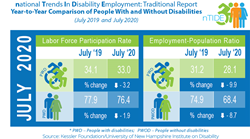
nTIDE info-graphic with employment statistics

“Comparing month-to-month numbers (June 2020 to July 2020), we see a leveling off of the employment-to-population ratio for people with and without disabilities, which may reflect regional resurgences of COVID-19 infections and restrictions of economic activity.” -John O’Neill, Kessler Foundation

Kessler Foundation and University of New Hampshire nTIDE Report—featuring the Just in Time Employment Supports Project, a multi-state project of the University of Iowa Midwest Disability Employment Consortium that implements virtual networks to support job coaches, workers, and employers

July job numbers raise concerns about long-term employment prospects for Americans with disabilities, according to today’s National Trends in Disability Employment – Monthly Update (nTIDE), issued by Kessler Foundation and the University of New Hampshire’s Institute on Disability (UNH-IOD). Prolonged unemployment may discourage workers, causing them to stop looking for work.

nTIDE COVID Update (month-to-month comparison)

In the Bureau of Labor Statistics (BLS) Jobs Report released Friday, the employment-to-population ratio for working-age people with disabilities decreased from 28.4 percent in June 2020 to 28.1 percent in July 2020 (down 1.1 percent or 0.3 percentage points). For working-age people without disabilities, the employment-to-population ratio increased from 67.7 percent in June 2020 to 68.4 percent in July 2020 (up 1 percent or 0.7 percentage points). The employment-to-population ratio, a key indicator, reflects the percentage of people who are working relative to the total population (the number of people working divided by the number of people in the total population multiplied by 100).

“Comparing month-to-month numbers (June 2020 to July 2020), we see a leveling off of the employment-to-population ratio for people with and without disabilities, which may reflect regional resurgences of COVID-19 infections and restrictions of economic activity,” said John O’Neill, PhD, director of employment and disability research at Kessler Foundation. “This is in contrast to the last several months, where we saw month-to-month improvements,” he added.

The labor force participation rate for working-age people with disabilities decreased from 34.4 percent in June 2020 to 33.0 percent in July 2020 (down 4.1 percent or 1.4 percentage points). For working-age people without disabilities, the labor force participation rate also increased from 76.2 percent in June 2020 to 76.4 percent in July 2020 (up 0.3 percent or 0.2 percentage points). The labor force participation rate is the percentage of the population that is working, not working and on temporary layoff, or not working and actively looking for work.

“A decrease in the labor force participation rate for people with disabilities raises a red flag,” cautioned economist Andrew Houtenville, PhD, research director of the University of New Hampshire’s Institute on Disability. “It suggests that workers are losing their jobs permanently after being on furlough, and have stopped looking for work and thus, exited the labor force,” “With the potential impact of the recent surges in COVID-19 cases, we should be concerned about long-term employment stress for people with disabilities.”

nTIDE August COVID Update – Friday, August 21 at 12:00 pm Eastern

Stay tuned for more about the employment of people with disabilities as we follow the impact of COVID-19 and look at the numbers in more detail.

Traditional nTIDE Numbers (comparison to the same time last year)

The employment-to-population ratio for working-age people with disabilities decreased from 31.2 percent in July 2019 to 28.1 percent in July 2020 (down 9.9 percent or 3.1 percentage points). For working-age people without disabilities, the employment-to-population ratio also decreased from 74.9 percent in July 2019 to 68.4 percent in July 2020 (down 8.7 percent or 6.5 percentage points).

The labor force participation rate for working-age people with disabilities decreased from 34.1 percent in July 2019 to 33 percent in July 2020 (down 3.2 percent or 1.1 percentage points). For working-age people without disabilities, the labor force participation rate also decreased from 77.9 percent in July 2019 to 76.4 percent in July 2020 (down 1.9 percent or 1.5 percentage points).

For reference, July 2020, among workers ages 16-64, the 4,063,000 workers with disabilities represented 3.0 percent of the total 134,977,000 workers in the U.S.    

Beyond the Numbers

The impact of the COVID-19 pandemic on the U.S. labor market is profound and ongoing. Millions of workers are affected across all sectors, with recovery hindered by resurgent outbreaks in the majority of states. Most severely affected are populations characterized by the intersections of race, poverty, and disability, and the organizations and agencies that support their transition to competitive employment and maximal independence. Technology has emerged as fundamental to the viability of businesses and nonprofit organizations, and to the ability of individuals to stay engaged in the labor force.

As the pandemic triggered lockdowns and closures, the advantages for individuals and organizations with technology-based work flows were immediately apparent, according to Elaine E. Katz, MS, CCC-SLP, senior vice president of the Center for Grants and Communications at Kessler Foundation. The majority of the Foundation’s recent COVID-19 emergency grants went to grantees with acute needs for computers, mobile technology, and internet connectivity.

Well in advance of the pandemic, the Foundation was aware of the potential for technology to improve the outcomes of disability employment initiatives. In 2017, a Kessler Foundation Signature Employment Grant funded the Just in Time Employment Supports Project, a multi-state project of the University of Iowa Midwest Disability Employment Consortium, funded through the State University of Iowa. The Consortium partnered with the University Centers for Excellence in Developmental Disabilities of Iowa, Nebraska, and South Dakota, to pilot the use of mobile technology, such as cell phones and tablets, as well apps for facilitating direct communication, to create virtual networks of support for job coaches, workers, and other stakeholders.

The two-year Just in Time Project yielded valuable information about the many ways that utilization of mobile technology in supported employment can encourage open communication, enable timely interventions, and foster greater independence for people with disabilities.

“We recognized that the integration of virtual platforms offered through Just in Time Supports was a way to improve employment outcomes. Incorporating communications technology means job coaches can maintain close contact with colleagues and clients, providing timely support that benefits workers and employers,” Katz said. “The ability to connect remotely means coaches can serve more clients, including those in rural areas, and provide more efficient services.”

The COVID-19 pandemic casts a new light on the findings of the Just in Time Support Project. “The use of technology in disability employment initiatives is no longer optional,” Katz asserted, “it’s essential.”

The Project’s structure and scale yielded another important asset − the Consortium has established a large and functional network throughout the Midwest. ‘The ability to act collectively will be of critical importance,” Katz added, “as the stakeholders in disability employment deal with the challenges and opportunities of the COVID economy.”

Ask Questions about Disability and Employment

Join our nTIDE Lunch & Learn series today, August 7, at 12:00 pm Eastern. This live broadcast, hosted via Zoom Webinar, offers attendees Q&A on the latest nTIDE findings, provides news and updates from the field, as well as invited panelists to discuss current disability-related findings and events. Wendy Parent-Johnson, PhD, director of the Sonoran University Center Excellence in Developmental Disabilities at the University of Arizona, and Julie J. Christensen, LMSW, PhD, director of Policy and advocacy at APSE, join Dr. Houtenville, Dr. O’Neill, and Denise Rozell, Policy Strategist at AUCD. Join live or watch the recordings at: ResearchonDisability.org/nTIDE.

NOTE: The statistics in the nTIDE are based on Bureau of Labor Statistics numbers but are not identical. They are customized by UNH to combine the statistics for men and women of working age (16 to 64). nTIDE is funded, in part, by grants from the National Institute on Disability, Independent Living and Rehabilitation Research (NIDILRR) (90RT5037) and Kessler Foundation.

About Kessler Foundation

Kessler Foundation, a major nonprofit organization in the field of disability, is a global leader in rehabilitation research that seeks to improve cognition, mobility, and long-term outcomes — including employment — for people with neurological disabilities caused by diseases and injuries of the brain and spinal cord. Kessler Foundation leads the nation in funding innovative programs that expand opportunities for employment for people with disabilities. For more information, visit KesslerFoundation.org.

About the Institute on Disability at the University of New Hampshire

The Institute on Disability (IOD) at the University of New Hampshire (UNH) was established in 1987 to provide a coherent university-based focus for the improvement of knowledge, policies, and practices related to the lives of persons with disabilities and their families. For information on the NIDILRR-funded Employment Policy and Measurement Rehabilitation Research and Training Center, visit ResearchonDisability.org.

For more information, or to interview an expert, contact:

Carolann Murphy, 973.324.8382, CMurphy@KesslerFoundation.org.