Category Archives: Health

What is new in the field of Health. Trending topics, and cutting edge research in the are of Health. Press Releases that give us updates on Health.

3D Ultrasound Enables Accurate, Noninvasive Measurements of Blood Flow


We had less than 10% error or variation. For some of the systems, we were down to only 3% to 5% difference between labs. These are fantastic results that show that, from a technology point of view, some systems could be ready to go to the clinic.

A 3D ultrasound system provides an effective, noninvasive way to estimate blood flow that retains its accuracy across different equipment, operators and facilities, according to a study published in the journal Radiology.

Measures of blood flow are important in helping clinicians determine how much oxygen and nutrient-carrying blood is reaching organs and tissues in a patient’s body. In emergency situations, accurate blood flow measurements can show if there is adequate blood supply to organs like the heart and brain. Blood flow measurements are important in chronic conditions too, as in the cases of measuring blood flow to the feet and lower limbs of people with diabetes.

Despite its importance, there is no ideal way to measure blood flow noninvasively and inexpensively. Current methods like blood pressure and 2D ultrasound (i.e., spectral Doppler) provide only surrogate metrics rather than the desired volumetric flow or have substantial limitations and are prone to errors. True flow measurements with 2D ultrasound are rarely used clinically due to reliability issues and cumbersome implementation. In addition, results often vary considerably between facilities and operators. Measurements from an experienced ultrasound technologist might differ significantly from those of a less experienced one.

“Right now, we just don’t have anything better to quantify blood flow,” said study lead author Oliver D. Kripfgans, Ph.D., associate professor of radiology from the Department of Radiology at Michigan Medicine in Ann Arbor, Michigan.

Dr. Kripfgans and his Michigan Medicine colleagues J. Brian Fowlkes, Ph.D., Stephen Z. Pinter, Ph.D., and Jonathan M. Rubin, M.D., Ph.D., have spent years developing and studying a 3D approach for quantitatively measuring blood flow. For the new study, he and his colleagues, along with other volunteers involved in the Quantitative Imaging Biomarkers Alliance (QIBA), tested this 3D approach on three clinical scanners using a custom flow phantom, a device that mimics blood flow in humans. They used seven different laboratories and manipulated the testing conditions by changing flow rate, imaging depth and other parameters for a total of eight distinct testing conditions.

The results showed that blood volume flow estimated by 3D color-flow ultrasound was accurate and reproducible among the seven laboratories.

“We had less than 10% error or variation,” Dr. Kripfgans said. “For some of the systems, we were down to only 3% to 5% difference between labs. These are fantastic results that show that, from a technology point of view, some systems could be ready to go to the clinic.”

Dr. Kripfgans credited the simplicity of the 3D approach, ease of data collection and elimination of assumptions plaguing other methods for minimizing the variation in results between users and systems. That simplicity, coupled with the availability of 3D on many existing ultrasound systems, is likely to hasten its arrival to clinical medicine, Dr. Kripfgans said.

“Once the technique becomes available commercially on scanners, clinical adoption will be much faster because then it’s not a research project anymore, it’s something that’s readily available, and after that it’s just a matter of time before it reaches the clinic,” he said.

QIBA, an alliance of researchers, health care professionals and industry representatives, was organized by the Radiological Society of North America in 2007 to improve current biomarkers and investigate new ones. Biomarkers are measurable indicators of the state of a person’s health.

The QIBA initiative includes collaboration to identify needs, barriers and solutions to create consistent, reliable, valid and achievable quantitative imaging results across imaging platforms, clinical sites, and time. QIBA aims to accelerate development and adoption of hardware and software standards to achieve accurate and reproducible quantitative results from imaging methods.

“Because of QIBA and this study I’m confident that this 3D ultrasound technology is on a path to the clinic,” Dr. Kripfgans said.

###

“Three-dimensional US for Quantification of Volumetric Blood Flow: Multisite Multisystem Results from within the Quantitative Imaging Biomarker Alliance.” Collaborating with Drs. Kripfgans, Fowlkes, Pinter and Rubin were Cristel Baiu, M.Sc., Matthew F. Bruce, Ph.D., Paul L. Carson, Ph.D., Shigao Chen, Ph.D., Todd N. Erpelding, Ph.D., Jing Gao, M.D., Mark E. Lockhart, M.D., M.P.H., Andy Milkowski, M.Sc., Nancy Obuchowski, Ph.D., Michelle L. Robbin, M.D., M.S., and James A. Zagzebski, Ph.D.

Radiology is edited by David A. Bluemke, M.D., Ph.D., University of Wisconsin School of Medicine and Public Health, Madison, Wisconsin, and owned and published by the Radiological Society of North America, Inc. (https://pubs.rsna.org/journal/radiology)

RSNA is an association of radiologists, radiation oncologists, medical physicists and related scientists promoting excellence in patient care and health care delivery through education, research and technologic innovation. The Society is based in Oak Brook, Illinois. (RSNA.org)

For patient-friendly information on ultrasound, visit RadiologyInfo.org.

Conversational-AI Platform Simply Speak helps physicians who use telemedicine during COVID-19, raises funding round to expand its growth


Simply Speak saves our physicians time, helps them communicate with their patients better, and ultimately improves both patients and physician satisfaction in a telemedicine setting.

Simply Speak (https://simplyspeak.com), the first conversational-AI platform built to help physicians using telemedicine to document their encounters with patients, is excited to announce a $1.1 million in seed funding to expand its growth during COVID-19.

Simply Speak enables physicians who are using telemedicine to document their interaction with patients while maintaining eye-contact. The platform leverages AI to extract meaningful medical data from the physician-patient conversation, and automatically place it back into the EMR.

The company has been bootstrapped since its inception. With the outburst of COVID-19, the company expanded to support physicians who are using telehealth and raised funding to scale its operations.

“The big advantage that telehealth has over a regular phone call is the ability to maintain eye-contact with the patient,” said Moti Tomashin, CEO and Co-Founder. “The absurd is that physicians now look away from the screen in order to take notes, losing the human connection that is so essential for the diagnostic process”. Simply Speak’s vision is to restore humanity to the practice of medicine by leveraging Conversational-AI – making physicians happier and creating more meaningful relationships between physicians and their patients.

Simply Speak Executive team includes seasoned leaders with global healthcare and AI experience: 33-year-old Tomashin was a successful healthcare attorney and an alumnus of an elite Israeli Army Unit; Yaron Aronsohn, CTO and Co-Founder, Ex. Chief Architect at Cyvera (purchased by Palo Alto Networks), and Glenn Loomis, MD, Chief Medical Officer and the company’s first investor, Ex. President and CMO at HealthQuest health system.

Advisory Board member Dr. Michael Ghalchi, Owner of Manhattan Cardiovascular Associates, added, “Simply Speak saves our physicians time, helps them communicate with their patients better, and ultimately improves both patients and physician satisfaction in a telemedicine setting.”

Simply Speak works by integrating with a provider’s EMR. Physicians can launch the Simply Speak application straight from the EMR, and review their notes at the end of the visit on the patient’s file on EMR. Physicians are used to counting clicks on their EMR; Simply Speak requires only three clicks of a button from beginning to end. Simple integration, plug & play documentation, and ease of use help physicians to save time, improve their well-being, and build better relationships with their patients.

About Simply Speak

Simply Speak (https://simplyspeak.com) is the first conversational-AI platform built specifically to help physicians using telemedicine document their encounters with patients. The company leverages Natural Language Understanding and Artificial Intelligence not only to document the medical encounter but also to make the medical data actionable for further use to improve healthcare outcomes. Simply Speak is based in New York and Tel Aviv, and serves HMOs, Physicians Groups, and Private Practices.

Share article on social media or email:

In the New ManListening Podcast, Women Share Stories of Trauma and Resilience


News Image

ManListening host Stuart Watson social distancing with guest Stacie Pompili-Towe

“We’ve created a podcast where real women control the narrative and talk about their lives in all their beauty and complexity.”

ManListening is a new podcast of conversations with strong women who faced tough times and bounced back, and one man who practices listening to them.

It’s an inspirational podcast founded on the certainty that women have something to say for this moment and the world will be better only when men start listening to women.

The “man listening” in this podcast is Emmy-award winning journalist Stuart Watson. “If you’re sick of the nonstop angry man shoutfest making you anxious, depressed and losing sleep, this is the quiet, peaceful, restorative place for you,” Watson says. “We’ve created a podcast where real women control the narrative and talk about their lives in all their beauty and complexity. We can all learn from their resilience.”

Women like Sheri Lynch, the brilliant radio broadcaster behind the syndicated “Bob & Sheri Show.” Sheri and Stuart swap poignant and funny stories about how they survived biological fathers with profound mental illness and addiction that wrecked their families.

And women like Sonja Chisolm, who became a mom at 16 and grew up to start “Gracious Hands,” a shelter for single moms with small children. Sonja reveals how she made peace with her own mother after a rocky start.

The idea for ManListening began three years ago when Stuart’s wife Lorraine told him during a stroll on the beach, “Sweetheart, you are not an empathic listener.”

She said he didn’t listen to understand other people’s feelings or empathize with them. The woman who knew him best gently added, “You’re particularly dismissive of women.” The conversation was a jolt to his ego and a turning point.

“I realize men don’t listen to women nearly often enough, and I was a prime example,” he says. “Men like me have done a poor job of listening to our mothers, sisters, wives, daughters, women colleagues and friends. I believe it’s long past time for a change, so I want to make a difference to lift up women’s voices.” That’s why the ManListening podcast is a place where women lead and men listen, where it’s always her turn to speak.

Every episode reinforces three simple words: Her story’s important.

ManListening is 100% member supported. Weekly episodes will always be free, but members get bonus material and free merch. Find out more at https://ManListening.com

ManListening is available wherever you get your podcasts. Follow ManListening on Facebook, Instagram, and Twitter @ManListening. If you want to know more about Stuart Watson’s professional background, check out LinkedIn.

More About ManListening

ManListening is a media company dedicated to supporting women in telling their stories, and men in active listening to women and asking great questions.

It’s led by veteran investigative journalist Stuart Watson. In the ManListening podcast, Watson engages women in conversation with no agenda but to hear them out, no mission but to understand, in the belief that one voice can change the conversation. His forthcoming book, WHAT SHE SAID & WHAT I HEARD, is a collection of personal discoveries he made after being confronted by strong women.

As a speaker, Watson talks from personal failures about why men can be so terrible at listening to women and how they can change. He also speaks on two other topics close to his heart: using his investigative skills to unearth family secrets like his own adoption, and recovery from alcoholism. Learn more at https://ManListening.com

Share article on social media or email:


National Alliance for Caregiving President and CEO Issues Statement on Need for Multicultural Data


Why hasn’t there been more progress in capturing the perspectives and needs of Black patients and caregivers?

The National Alliance for Caregiving President and CEO, C. Grace Whiting, has issued a statement on the need for multicultural data in America’s health and social care systems. This statement was written in response to recent injustices facing Black Americans and the disproportionate impact of COVID-19 on this community. Recognizing that research in the field of healthcare has often taken a one-size-fits all approach, Whiting calls for the inclusion of the lived experiences of diverse populations in health and social care research. See her statement below, or by visiting http://www.caregiving.org/no-more-one-size-fits-all-research/.

Dear Friends:

This Juneteenth, I attended a national workshop on patient engagement and research agendas. Toward the end of the discussion, advocates raised an issue that’s been top of mind: racial equity. Why hasn’t there been more progress in capturing the perspectives and needs of Black patients and caregivers?

Feathers began to ruffle.

Well-meaning scientists and policy experts were put on the defensive. Inevitably, the 1932 Tuskegee Experiments came up as a way to acknowledge the historical fears in minority communities that contribute to gaps in representation. The Tuskegee Experiments were that shocking and horrifying “study” where Black men with syphilis were not treated for the disease so that scientists could track the course of the untreated disease. Where Black men and their families were not told that the patients would not receive any treatment. The experiment was supposed to last six months; it lasted for 40 years.

It’s easy to point to Tuskegee as a historical byproduct of days gone by—but the reality is that racial injustice in healthcare did not stop with Tuskegee. It continues today in a quieter, more passive way: assuming a one-size-fits-all solution that ignores the lived experiences of diverse populations.

Nearly a hundred years since the Tuskegee Experiments began, nearly forty years since the disability rights movement took off, researchers and policymakers still need to hear, “Nothing about us, without us.”

Look no further than the COVID-19 pandemic to see how racial injustice opens the door for health disparities. Despite public health advisories that Black and Latino families face heightened risk for the coronavirus, Johns Hopkins has indicated that only four states have released breakdowns of COVID-19 data by race (Nevada, Kansas, Illinois, and Delaware). The CDC is clear that “current data suggest a disproportionate burden of illness and death among racial and ethnic minority groups.” Yet, the policy community lacks data to track what is happening to these families.

The CDC notes that health differences in COVID-19 between White families and families of color are “often due to economic and social conditions” such as:

  • Years of residential housing segregation resulting in more densely populated areas, increasing the risk of contagion.
  • Food deserts, which make it harder for families to get access to nutritious meals, and in turn increases the risk of chronic disease (another risk factor for COVID-19).
  • Overrepresentation of minorities in jails, prisons, and detention centers which increases threats to their lives because of a higher risk of catching COVID-19 in these settings.

These health risks are in addition to the fact that the pandemic’s economic fallout – which threatens food, housing, and income security for so many families – is being shouldered by Black businesses, as nearly 440,000 firms have folded (41% of all small business closures).

While the health policy community debates the cost or inconvenience of integrating diverse populations into research design, caregivers are making it work in real time despite a system designed without them in mind and in the midst of a global pandemic. The need to make meals for someone doesn’t stop because the grocery store has limited hours. The spouse or partner still has to pay medical bills even if the pandemic has created new economic pressures. Parents of kids with special needs still have to navigate individualized education plans and insurance paperwork even if schools are closed.

Caregivers keep on, despite the roadblocks continually put in their way.

For our part, we at the National Alliance for Caregiving are committing to equity and justice. We have joined the Diverse Elders Coalition and the John A. Hartford Foundation as they work to address the needs of caregivers in Black, Latino, Asian American, Native American, and the LGBTQ+ community. We’re working with innovative companies like Amgen and seeking insight from nonprofit leaders such the National Minority Quality Forum to analyze the needs of multicultural care communities for a national report on caregivers of color. We will join the newly-launched Rare Disease Diversity Coalition, led by the Black Women’s Health Imperative, to address the challenges facing diverse populations in rare disease.

And, our data set from Caregiving in the U.S. 2020, a partnership with AARP going back to 1997, is one of the few caregiving data sets with nationally representative data of minority populations in the U.S. It reveals that four out of ten caregivers (39%) in the United States are non-white (14% Black, 17% Latino, 5% Asian American, and 3% other including multiracial). It also shows that Black caregivers are more likely to say that they are in worse health and more likely to want health care professionals to ask them what they need to help care for themselves—indicating a persistent lack of support for their well-being.

On a closer look, the data challenge preconceived notions about minority populations. Latino and Black families are more likely to say caregiving gives them a “sense of purpose” and meaning in life than their White and Asian counterparts. Despite giving more hours of care on average and being placed in higher-intensity care situations, these families report less emotional stress. Perhaps these communities understand something about resilience that the rest of us have yet to master?

It’s past time we moved forward to be more inclusive and transparent in order to reduce patient risk and assign value to patients’ health and well-being. Let’s take a lesson from those who care in understanding what they need, rather than telling people and caregivers that we know best based on unrepresentative data and outdated cultural understandings of need. If caregivers can stand strong, day after day, despite a global pandemic, despite inequities, despite political unrest, we too can get up every day, with hope in our hearts, with resilience in our spirit, ready to build a more caring world.

Frankly, we owe them that.

C. Grace Whiting

President and CEO

National Alliance for Caregiving

Share article on social media or email:

Global Billionaire Population and Wealth Surged to All-time High in 2019


Wealth-X, the world’s leading provider of data and insight on the wealthy, today released The Billionaire Census 2020. The seventh edition of this unique report analyzes the status of the world’s billionaire population, a modest number of individuals who hold immense wealth and significant influence over the global economy.

While prior editions of the Billionaire Census showcased only data from the previous year, this new report also includes key intelligence from the first months of 2020 to provide early insight into the economic impact of COVID-19.

In 2019, the size of the global billionaire population increased strongly, rising by 8.5% to 2,825 individuals, more than reversing the previous year’s decline and reaching an all-time high. The combined wealth of the world’s billionaires outpaced the population’s growth in 2019, rising by 10.3% to $9.4 trillion.

This significant growth was led returns across almost all major asset classes, despite a loss of momentum in the global economy and a still turbulent geopolitical environment. The bullish performance in financial markets was largely driven by a flood of central bank liquidity, delivering a boost to investor sentiment and global equities.

There were regional variations in wealth gains that reflected the volatile geopolitical backdrop and contrasting national economies, with North America and Asia seeing the strongest returns, and only subdued wealth creation in the Middle East and Latin America.

Among numerous findings, the Billionaire Census 2020 reveals:


  • China billionaire population expanded the most rapidly – though the US is still home to the largest number of billionaires at 788.
  • Average billionaire net worth has been significantly impacted by the economic fallout from COVID-19 – though the number of billionaires in several industries, such as technology, grew by at least 6% in the first part of 2020.
  • Over 10% of billionaires donated toward the fight against COVID-19 – with others giving coming anonymously or in the form of non-monetary commitments.
  • Billionaires pledging to COVID-19 causes differ from traditional major billionaire donors – those giving toward causes that fight the pandemic are, on average younger, wealthier and more likely to have created their own wealth.

The Billionaire Census 2020 also includes research on the top billionaire countries and cities around the world, the leading industries for billionaire creation, and the most popular interests, passions and hobbies of this exclusive population.

For the complete findings, download the full report at http://www.billionairecensus.com

About Wealth-X

The global leader in wealth information and insight, Wealth-X partners with prestige brands across the financial services, luxury, nonprofit and higher-education industries to fuel strategic decision-making in sales, marketing and compliance. Wealth-X has developed the world’s largest collection of records on wealthy individuals and produces unparalleled data analysis to help organizations uncover, understand, and engage their target audience, as well as mitigate risk. Founded in 2010, with staff across North America, Europe and Asia, Wealth-X provides unique data, analysis, and counsel to a growing roster of over 500 clients, worldwide.

Share article on social media or email:

Sencorp Announces Strategic Partnership with WM Thermoforming Machines


News Image

Sencorp, a leading manufacturer of thermoforming machines, today announced a strategic partnership with WM Thermoforming Machines, who develops new process improvements and tailor-made solutions responding the specific and changing requirements of each customer. This partnership strengthens Sencorp’s leadership position in reliable thermoforming equipment and provides North American manufacturers a broader range of thermoforming solutions to optimize processes for food, consumer, industrial and medical applications.

WM Thermoforming Machine’s all-electric, small footprint, and high-speed thermoformers complement the Sencorp line, and combining Sencorp reliability with WM agility allows the companies to create solutions based on each manufacturer’s specific requirements. For example, in addition to the existing Sencorp roll-fed, in-line thermoforming technology, the North American packaging industry will now be able to obtain up-stream and down-stream solutions, such as automated robotic off-load, laser cutting, bagging, rimming, and extrusion under the co-branded name.

The partnership will also enhance WM’s capabilities to meet customer’s thermoforming requirements with a highly qualified and expert service team, providing world-class support for their innovative products and new automation technologies.

By complementing Sencorp’s technology and expanding WM’s technical support and service capabilities, a wide range of focused solutions are readily available. Together, SencorpWhite and WM are able to deliver unparalleled options to food, consumer, industrial and medical applications.

For more about Sencorp’s partnership with WM Thermoforming Machines visit https://sencorpsystems.com/wm/

About Sencorp:

Sencorp is a leading Thermoforming machine manufacturer located in Massachusetts. Sencorp Thermoformers are used for manufacturing blister packs, clamshells, trays, and disposable containers. They are engineered to reliably produce high volume, quality parts from most major polymers. Sencorp machines are used for many markets including consumer, medical, pharmaceutical, food, and automotive.

About SencorpWhite:

SencorpWhite is a leading provider of unique end-to-end solutions for the packaging and management of high-value inventory. The company’s products and services– which range from White automated storage and retrieval systems, Sencorp Thermoformers, CeraTek and Accu-Seal heat sealers, and Intek and Minerva item management software– cover the entire supply chain, from the point-of-manufacture through distribution and to the point-of-use. For more information, call (508) 771-9400 or e-mail communications@sencorpwhite.com.

About WM Thermoforming Machines:

WM Thermoforming Machines S.A. is considered as one of the most important thermoforming manufacturers in the world and is enjoying great international prestige for producing reliable, high-performance state-of-the-art machinery. The company based in Stabio, Switzerland, has been designing and manufacturing thermoforming machines since 1981 and complete IN-LINE plants with extrusion technology since 1992. For more information, visit: http://www.wm-thermoforming.com

Follow Us:

https://www.linkedin.com/company/sencorp-systems/

https://twitter.com/sencorpwhite

https://www.facebook.com/SencorpWhite-1592452881046361/

https://www.instagram.com/sencorpwhite/

https://www.youtube.com/channel/UCKITGVQlcBaKCFjX_QkujPg

PR Contact:

Scott Boyson, Marketing and Sales Operation Manager

Phone: (508) 771-9400

Email: communications@sencorpwhite.com

Share article on social media or email:


Catalent Expands Beauty and Plant-Based Consumer Health Softgel Capabilities at its Facilities in Canada and Brazil


News Image

We have seen increased consumer demand for greater product choice, with sales of plant-based softgel technologies growing by more than 25% globally in recent years

Catalent, the leading global provider of advanced delivery technologies, development, and manufacturing solutions for drugs, biologics, cell and gene therapies, and consumer health products, today announced the completion of a $3.2 million expansion program at its consumer health manufacturing facilities in Strathroy, Canada and Sorocaba, Brazil.

The expansion projects include new softgel encapsulation lines at each site, dedicated to Catalent’s proprietary Vegicaps® plant-based capsule and CosmoPod® twist-off capsule technologies. The increased capacity will enable Catalent to support its customers in both North and Latin America to develop products for consumers seeking all-natural and plant-based vitamins, minerals and supplements, using its Vegicaps capsule; and those looking for innovative, easy-to-use, unit-dose beauty care products, through its CosmoPod technology.

“We have seen increased consumer demand for greater product choice, with sales of plant-based softgel technologies growing by more than 25% globally in recent years. Additionally, Brazil has grown to become the world’s fourth-largest market for beauty care products,” commented Dr. Aris Gennadios, President, Softgel & Oral Technologies, Catalent. “While we have been supplying the North and Latin American markets with plant-based softgel capsules from our manufacturing sites in Italy and Germany, this investment allows us to provide local supply solutions to markets that complement existing capabilities in Europe.”

Catalent’s 110,000 square-foot facility in Strathroy, Ontario, and its 124,600 square-foot facility in Sorocaba, Brazil, both offer a broad range of integrated formulation, manufacturing, and packaging services to provide full-service turnkey solutions for the pharmaceutical, consumer health, and beauty industries.

For more information about Catalent’s Consumer Health capabilities, please visit https://consumerhealth.catalent.com

About Catalent Consumer Health & Beauty

Catalent brings over 85 years of experience and expertise in softgel, fast-dissolve, and oral solid dose formulation development and supply of over-the-counter, nutritional supplement and beauty products to market. With consumer-preferred dose forms and advanced development and commercial manufacturing expertise, Catalent helps differentiate and grow brands, to get better products to market faster. Catalent partners with 23 of the top 25 consumer health companies and produces more than 5,000 consumer health and beauty products, which are marketed in more than 70 countries. For more information, visit consumerhealth.catalent.com

About Catalent

Catalent is the leading global provider of advanced delivery technologies, development, and manufacturing solutions for drugs, biologics, cell and gene therapies, and consumer health products. With over 85 years serving the industry, Catalent has proven expertise in bringing more customer products to market faster, enhancing product performance and ensuring reliable global clinical and commercial product supply. Catalent employs over 13,500 people, including over 2,400 scientists and technicians, at more than 40 facilities, and in fiscal year 2019 generated over $2.5 billion in annual revenue. Catalent is headquartered in Somerset, New Jersey. For more information, visit http://www.catalent.com

More products. Better treatments. Reliably supplied.™

Share article on social media or email:

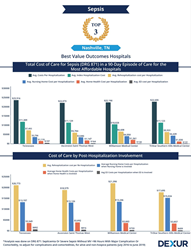
Ascension Saint Thomas West, Williamson Medical Center, and TriStar Southern Hills Medical Center have the best value outcomes for Sepsis in Nashville, TN


best value outcomes for Sepsis in Nashville, TN

“Dexur’s value analysis tracks a patient’s episode of care from the date of admission for 90 days and includes the index hospitalization, rehospitalization, home health, nursing home, and ED costs.”

Dexur’s analysis of medicare claims of hospitals within a 25-mile radius of Nashville, TN, showed that Ascension Saint Thomas West, Williamson Medical Center, and TriStar Southern Hills Medical Center had the best value outcomes over a 90 day episode for Sepsis. Dexur’s value analysis tracks a patient’s episode of care from the date of admission for 90 days and includes the index hospitalizations, rehospitalization, home health, nursing home, and ED costs. Total cost of care data helps patients make appropriate choices and helps local ACOs, such as Connected Care of East Tennessee, LLC, Ascension Care Management Health Partners Tennessee, and Cumberland ACO, LLC, make appropriate referral choices. The analysis was risk-adjusted, for alive and non-hospice patients and was done at the DRG level, specifically DRG 871: Septicemia Or Severe Sepsis Without MV>96 Hours With Major Complication Or Comorbidity, to adjust for complications and comorbidities.

Ascension Saint Thomas West’s total cost of care over a 90 day episode was $22,073 (for the period between July 2016 and June 2019). The index hospitalization cost was $11,129 and the average rehospitalization cost per hospitalization was $5,784. The cost per rehospitalization was at an average of $18,579. Meanwhile, the average ED costs per hospitalization (when ED is involved) was $816.

Williamson Medical Center’s total cost of care over a 90 day episode was $22,190 (for the period between July 2016 and June 2019). The index hospitalization cost was $10,028 and the average rehospitalization cost per hospitalization was $6,608. The cost per rehospitalization was at an average of $21,398. Meanwhile, the average ED costs per hospitalization (when ED is involved) was $733.

TriStar Southern Hills Medical Center’s total cost of care over a 90 day episode was $22,655 (for the period between July 2016 and June 2019). The index hospitalization cost was $11,123 and the average rehospitalization cost per hospitalization was $5,931. The cost per rehospitalization was at an average of $17,695. Meanwhile, the average ED costs per hospitalization (when ED is involved) was $659.

Share article on social media or email:

Pharmacy Benefits Optimizer RxBenefits Appoints Kelly Chillingworth, RPh, as Northeast Business Development Director


News Image

“Employers need an advocate that truly understands the benefits landscape as they navigate the complexities of health plans and rising drug costs,” said Bryan Statham, CEO of RxBenefits.

RxBenefits, the industry’s first and only technology-enabled pharmacy benefits optimizer (PBO), has named Kelly Chillingworth, RPh, MHA-Ed, CGP, director of business development for the company’s northeast region.

RxBenefits serves as a trusted pharmacy adviser to employee benefits consultants, enabling them to offer self-insured employers and their members a highly competitive, cost-effective pharmacy benefits solution, irrespective of company size. Chillingworth will lead RxBenefits’ northeast sales team in business development planning and activities. In this role, she will drive the region’s strategic growth plan, leveraging her deep industry expertise and knowledge as a registered pharmacist to help employee benefits consultants identify and solve their self-funded clients’ toughest pharmacy benefit challenges.

“It is more critical now than ever for businesses to be able to provide best-in-class pharmacy benefits at affordable rates. Employers need an advocate that truly understands the benefits landscape as they navigate the complexities of health plans and rising drug costs,” said Bryan Statham, CEO of RxBenefits. “Kelly’s deep industry experience as both a pharmacist and a benefits consultant, combined with a dedication to improving the lives of others, brings a unique perspective and strength to our team as we help our clients develop customized pharmacy benefits strategies.”

Chillingworth has over 26 years of experience as a pharmacist, giving her a unique understanding of the intricacies of pharmacy benefits through the lens of a clinician. Before joining the RxBenefits team, Chillingworth held various positions in the benefits industry, including director level titles at a health plan and specialized renal pharmacy, as well as senior-level titles at employee benefits consultant firms. Recently, she served as the National Pharmacy Practice Leader for Lockton Benefits Group and as Senior VP, Pharmacy Practice Leader for the Lockton Kansas City Series.

“As an industry, there is much more we can do to ensure patients are on the right drug, at the right dose, at the right time. I am passionate about providing people with the information they need to make informed healthcare decisions, which is what drove me to join this industry decades ago,” said Chillingworth. “My experience first partnering with RxBenefits as a benefits consultant enabled me to see the significant impact the company’s approach to pharmacy benefits can have on self-insured businesses and their employees. I am ecstatic to leverage my experience to help employee benefits consultants and their clients reduce the cost of pharmacy benefits while, at the same time, increase value and safety for members.”

Chillingworth is a registered pharmacist (RPh) and holds a Bachelor of Science in Pharmacy (BS Pharm) and Master of Healthcare Administration and Education (MHA-Ed). She also holds certifications in pharmacogenomics and is board certified in geriatric pharmacy (CGP).

About RxBenefits

RxBenefits is a technology-enabled pharmacy benefits optimizer (PBO) with more than 500 pharmacy pricing, data, and clinical experts working together to deliver prescription benefit savings to employee benefit consultants and their self-insured clients. With nearly 2 million members, RxBenefits brings market-leading purchasing power, independent clinical solutions, and high-touch service to its customers – ensuring that all businesses, regardless of size, can provide an affordable and valuable pharmacy benefit plan to their employees. The company is headquartered in Birmingham, AL. For more details, visit http://www.rxbenefits.com or follow the company on Facebook, Twitter, and LinkedIn.

Share article on social media or email:


DSS, Inc. Adds to Executive Leadership Team with New Promotions


News Image

“Rodney and Kelly have been members of the DSS family for many years, and I’m very pleased to welcome them to the executive leadership team,” said Mark Byers, President of DSS, Inc., and a 2020 FedHealth IT 100 awardee.

Document Storage Systems, Inc. (DSS, Inc.), a leading provider of health information technology (HIT) solutions for federal, private and public healthcare organizations, today announced the expansion of its leadership team with the promotion of two executives who have been instrumental in the company’s growth. Rodney Neal has been appointed Vice President, Sales and Marketing, and Kelly Kavooras will fill the new role of Chief Marketing Officer.

A core part of DSS, Inc.’s success in providing cutting-edge health information software and systems integration solutions is its people. As a family-owned business, the company has fostered a special organizational culture that has helped propel its success.

Neal has a long track record of executing revenue strategies at DSS, Inc. In his new role as Vice President he will provide strategic and operational leadership for all company activities designed to reach revenue and marketing goals. As a member of the executive team, Neal will collaborate with cross-functional management teams to align corporate plans with revenue and market share targets.

Kavooras was promoted from her previous position as Marketing Director at DSS, Inc. A seasoned marketer with over a decade of healthcare marketing experience, Kavooras will be responsible for developing and implementing marketing and documentation strategies across multiple business lines to better support customers and contribute to the growth of the company.

“Rodney and Kelly have been members of the DSS family for many years, and I’m very pleased to welcome them to the executive leadership team,” said Mark Byers, President of DSS, Inc., and a 2020 FedHealth IT 100 awardee. “Our company has grown steadily since our founding, and much of the credit goes to our special corporate culture and executives like these.”

DSS, Inc. has transformed from six employees in 1998 into a company with more than 600 employees in offices across the country. For over 25 years, the company has led the way for healthcare innovation, creating solutions that improve revenue cycles, regulatory compliance, interoperability, and above all, patient care.

About Document Storage Systems, Inc. (DSS, Inc.)

With over 25 years of experience, DSS knows what works. We are a health information software development and systems integration company, providing services and solutions used daily by thousands of clinicians and administrative staff nationwide, to reduce costs, streamline workflows and improve patient care. For more information about DSS, visit http://www.dssinc.com.

Share article on social media or email: